Fifty years ago this winter, on 29 November 1975, a bomb tore through Dublin airport during the busy afternoon rush. Luggage handler John Hayes was killed instantly, and nine others were injured. Once again, Dublin was the target of loyalist paramilitary violence.
A second bomb detonated shortly afterwards. By that point, however, the airport had been evacuated, narrowly averting a repeat of the mass slaughter inflicted by the 1974 Dublin bombings.
Responsibility for the airport attack was initially pinned on the Ulster Defence Association (UDA). A list of suspects was reportedly drawn up by the Gardaí. Yet, inexplicably, the investigation was rapidly wound down. To this day, no one has been held accountable. No one has been brought to justice. For half a century, the truth has been smothered beneath a thick fog of obfuscation.
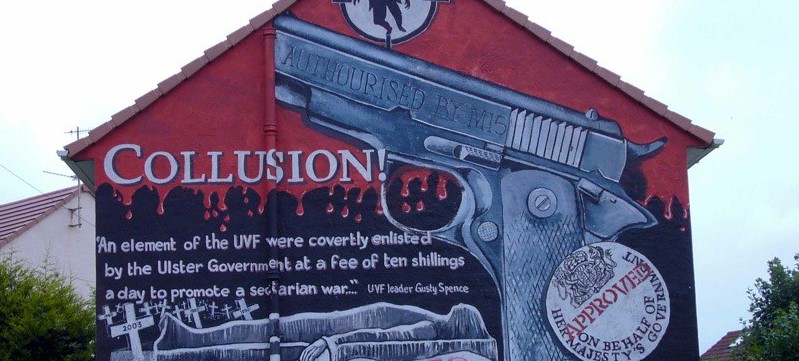
Only in recent weeks has the release of the Operation Denton report revealed that behind the bombs stood not the UDA, but the notorious Ulster Volunteer Force (UVF) Glennane Gang – a hotbed of collusion between loyalist paramilitary and British security forces. This can help us shed light on why the truth – on this and other loyalist attacks of the period – is so carefully concealed.
‘Year of Madness’
1975 has been described as a ‘year of madness’ during the Troubles. The Officials had by then effectively wound down their military campaign, and the year opened with a ceasefire by the Provisional IRA.
Years of British propaganda have portrayed loyalist violence as reactive or “defensive”. What followed the ceasefire blows that lie apart. Fearing that British imperialism was preparing to compromise, loyalist paramilitaries launched an all-out campaign of sectarian murder. Their aim was to drown the ceasefire in blood, provoking retaliation and reigniting the conflict.
As so often happened during the Troubles, the British state did not confront loyalist terror. Instead it sought to ‘reason with’, ‘negotiate’ and ‘manage’ loyalist killers. Almost incredibly, both the UDA and the UVF were legal organisations for much of 1975.
This kid-gloves approach – and the impunity afforded to loyalist killers – fuelled the slaughter. More than 120 innocent Catholics were killed as a result in that year alone. But even that is not the full story.
Glennane Gang
Operation Denton has now confirmed that the most brutal of these attacks were carried out by the Glennane Gang.
This was no rogue outfit. It was a lethal alliance of UVF members, RUC officers, UDR soldiers, and British intelligence assets – paramilitaries working hand-in-hand with police officers and army ranks – operating from a farmhouse in Glenanne, County Armagh. From that base, the group carried out scores of sectarian attacks, murdering 127 people. Their victims included those killed in the Dublin and Monaghan bombings, the Miami Showband massacre, the Gilford minibus shooting, and the Dublin Airport bombing.
The British state was forced to launch Operation Denton – a review into the gang’s activities – only after decades of struggle from victims’ groups, and following confessions by a Glenanne member. Even then, it was never intended as an investigation. As John Hayes’s son recently put it, “it’s a British PR exercise”, designed to limit political damage.
Yet even within these constraints, the findings are damning. The report admits to: “evidence of the active involvement of members of the security forces with loyalist paramilitary groups,” including “bombing attacks and murder.” And it further acknowledges that loyalist gangs were “regularly supplied with intelligence” by those same forces.
Even though the report attempts to shift blame onto “corrupt elements”, the facts are clear. The British state armed, protected, infiltrated – and in some cases directed – one of the most lethal loyalist groups of the conflict.
Dig a little deeper and the picture becomes even clearer. The Glenanne Gang’s staff instructor was Billy Hanna – until he was killed by the UVF for being an agent. Robin “the Jackal” Jackson – a central figure in the Dublin bombings – was widely alleged to have close ties to Special Branch.
Is it any wonder, then, that investigations were strangled at birth? That evidence vanished, files were buried, and the truth had to be dragged out piece by piece by grieving families and tireless campaigners? What might a full reckoning still expose?
Still no justice!
As a matter of fact, this pattern is repeated throughout the Troubles. Loyalist paramilitaries may not have been created by the British state, but collusion with them was pervasive.
The events in Dublin also lay bare the hypocrisy of the Southern ruling establishment. While posturing as opponents of British imperialism, when given the chance to expose its crimes they instead moved quickly to hush up investigations and bury the truth.
Fifty years on, no one has been prosecuted for the Dublin Airport bombing – nor for most crimes committed under the shadow of British collusion. Afterall, justice is never handed down by the institutions that committed the injustice in the first place.
Following the Good Friday Agreement, the British state spoke grandly of a fair and comprehensive reckoning with the past. Like so many of its promises, this has been exposed as a cynical manoeuvre designed to draw a line under its own crimes. True justice will only be won when imperialism is driven from this island once and for all.