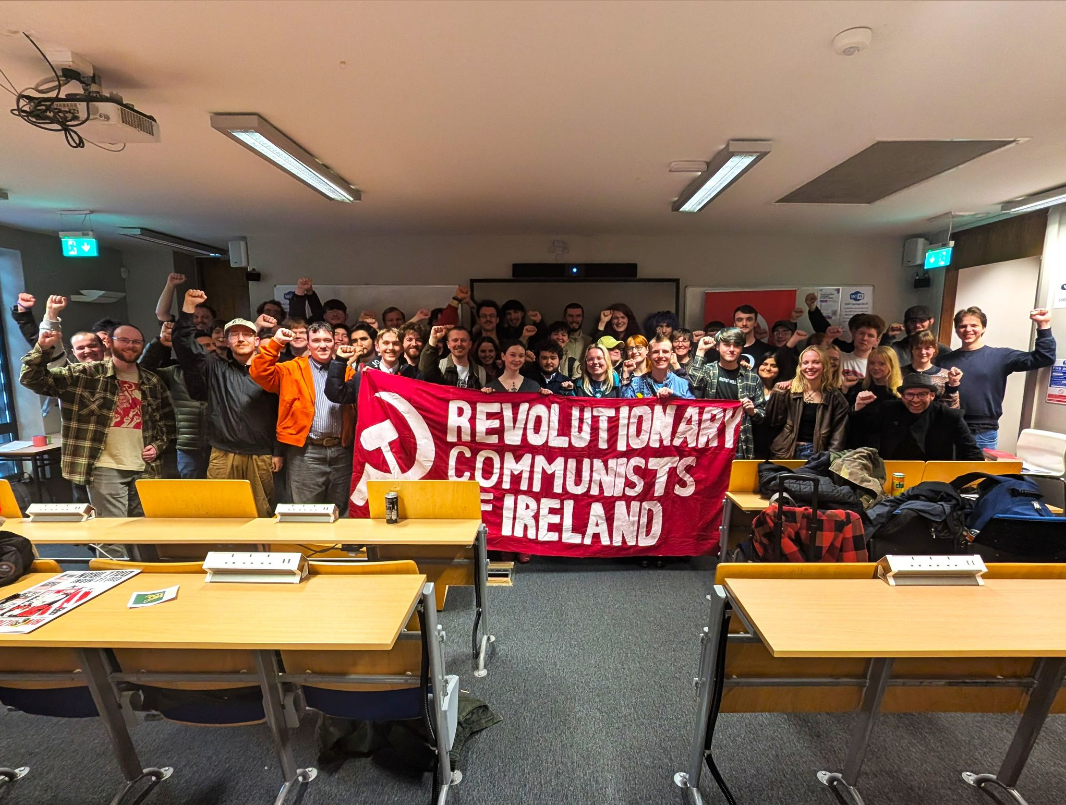
The following document was passed unanimously at the third congress of Revolutionary Communists of Ireland. Here, we offer our perspective and analysis of the main trends that are shaping Irish politics and the class struggle. If you agree with the ideas here explained, then there is no time to lose. Write to us today and join the fight for communism!
Momentous events are unfolding on the stage of world capitalism. The consciousness of millions – indeed billions – across the globe is being jolted awake by an unrelenting series of sudden twists and turns.
2025 will go down as a watershed in the history of capitalism: the year when the liberal world order began to crumble. A year that opened up with the coming into office of Donald Trump for his second term, and that closed with the ‘Gen Z’ revolutions across South-East Asia and beyond, developing alongside mass, militant movements of workers and youth in Europe ignited by the genocide in Palestine. It was a year punctuated by wars – military and economic alike – and by revolutions. And 2026 offers no prospect of respite for the ruling classes of this planet, nor for hundreds of millions of workers all around the globe.
Due to its position on the fault lines between different imperialist blocs, capitalist Ireland – in and of itself an inconspicuous country on the world stage – stands out as particularly vulnerable to the new world situation. The ground is preparing for a rapid unravelling of the material basis on which Irish capitalism – North and South – has thus far rested, with far-reaching implications for the development of the class struggle.
An epoch of rapid radicalisation – to the left and to the right – is opening up, on a scale unseen for decades. The opportunities opening up in front of us to build a sizeable communist organisation – necessary for the ultimate victory of the working class – are practically boundless, and still growing by the day.
This perspectives document is therefore intended not as an academic exercise, nor a detached commentary on world events. It is a tool to help orient us in our work to achieve this historic task. As Trotsky explained in 1924, Marxists “analyse history from the standpoint of the social revolution. This standpoint is at one and the same time both theoretical and practical, dynamically so. We analyse the conditions of development as they take shape behind our backs [in order] to act upon them.” Comrades, in developing, discussing and voting on this document we are not only agreeing to the letters hereby printed – but above all to its spirit and the revolutionary actions that inevitably flow from it.
In talking about perspectives, it is always important to stress that we do not, of course, possess the finished script of history. Perspectives are inherently provisional. Our job is not to predict every twist and turn in advance – which is impossible – but to identify the underlying tendencies, the main lines of development, and – above all – their implications for the class struggle.
The world turned upside down
An Irish Perspectives document is not the place to develop a comprehensive analysis of the world situation – for that, we direct comrades to the World Perspectives document adopted by the first World Congress of the Revolutionary Communist International, which should be read alongside the current text. That said, it is simply impossible today to understand any major development in Ireland without tracing its roots to the seismic forces reshaping world capitalism.
Trump’s first year back in office has delivered a mighty blow to the liberal order that has reigned over the capitalist world since the end of the Second World War. It signified a major shift in capitalism.
The main motor force of capitalist development in the 1990s and 2000s – so-called ‘globalisation’ – is now the memory of a bygone era. In its place we see economic nationalism, protectionism, and open imperialist confrontation. The world’s biggest economic power has imposed the highest tariffs since the 1930s. NATO – the military pillar of Western imperialism for 77 years – is tearing at the seams. Russia is inflicting a humiliating defeat on the West in Ukraine. China and the US have faced each other in a tariff stand-off, in which the former gained the upper hand. The Middle East, already rife with chaos, is edging ever closer to disaster. Trump has torn away the last fig leaf of the ‘international rule of law’, launching interventions – such as in Venezuela – without even the pretence of ‘democracy’ or ‘humanitarian’ excuses.
To be sure, rather than being the cause of this chaos, Trump is only the most personified expression of a new world situation. At its core, what we are witnessing today are preparations for, and the opening shots of, a struggle for the re-partition of the world between rival imperialist blocs. This reflects a qualitative shift in the global balance of forces that has been building up for years. The so-called international rules-based order was underpinned by the uncontested military and economic dominance of the United States as the world’s only imperialist superpower. But now, the relative decline of US imperialism over decades and the rise of competing imperialist powers – Russia, and above all, China – capable of confronting it on a world scale, have irreversibly overturned that setup.
The recently released US National Security Strategy spells this out almost to the letter. The US is no longer able to impose its hegemony all around the world and at all times. It therefore needs to retrench to its immediate spheres of influence in the Western Hemisphere, which it aims to consolidate through naked economic and military might. This is the single, most important factor behind perspectives all around the world.
For the European imperialists, the new world situation spells disaster. Imperialism is at its heart predicated on economic power, backed by military power. But the Europeans have neither. They have the most to lose from a new re-partition of the world among the great superpowers. For decades, they carved out a place for themselves as junior partners of US imperialism. Now, with the US pivoting away from the continent to focus on America and the Pacific, they’ll be left to fend for themselves in an increasingly turbulent world. And to be sure, Trump is not just disinterested in propping up the Europeans, he is actually interested in squeezing them as much as possible in order to strengthen America’s own position.
Finally, on top of all the instability caused by the shifting and clashing of the tectonic plates of world imperialism, the prospects for the world economy are anything but rosy. 18 years on since the financial disaster of 2008, unprecedented overproduction is once again glutting world capitalism, and fuelling a wave of speculation in the stock market. As the Financial Times put it: “Be warned. We are reliving the Roaring Twenties… Artificial Intelligence euphoria is rampant, crypto lunacy is rife, credit is bubbling in private markets and the US is once again at the heart of a global fiscal and financial maelstrom. Close to a hundred years on, we have to ask: does another 1929 crash loom?”
Combined with almost two decades of profound capitalist crisis, this is only throwing fuel to the flames of class anger – and by the bucketful. Aside from the ‘Gen Z’ revolutions and the ‘Block Everything’ movements already mentioned above – at the time of writing, the year has barely begun and we have already witnessed an explosion of anger in the US over ICE violence, with the first city-wide general strike in the US for more than half a century.
In virtually every country around the world, after a decades-long slumber, workers and youth are finding their feet and are moving toward militant struggle. In the absence of a genuinely revolutionary channel for their anger, the class struggle is erupting with fits and starts. A country’s political situation can change into its opposite in mere moments. But underneath the surface, powerful forces are shaping the consciousness of workers and youth.
Surrounded by blades
This is the context in which events in and around Ireland are now developing at an accelerating pace. What, after all, were the absolutely fundamental conditions for the success of Irish capitalism over the past three decades? Globalisation, plus the political, diplomatic and economic integration of the US, EU and Britain. And isn’t this precisely what the latest American strategy is directed against?
We have discussed at length the economic risks arising from Trump’s second term in office and the US’ conflict with Europe in last year’s perspectives document – which should be considered a necessary reading alongside the current text – and we are not going to repeat ourselves here. But now, what could be traced only in broad strokes back then, is increasingly taking shape in front of us. And the direction of travel is unmistakable. It doesn’t bode well for Irish capitalism.
As we have already explained many times, the fundamental issue is this: Ireland is economically dependent on the United States – virtually entirely so, in fact. But its economic success rested to a great extent in providing a ‘bridge’ between American capital and Europe. In other words, Ireland stands to lose more than any other EU state from Trump’s drive to discipline and subordinate Europe. And there is nothing fundamental the Irish ruling class can do about it.
Their instinctive response to this new world situation has been to try and hide themselves in their kitchen cabinet – to become as inconspicuous as possible, to plead for moderation and appeasement in the EU’s response to Trump. If we submit quietly – they reason – perhaps we can secure the least-worst outcome. But the objective logic of the situation is pushing Ireland not into the background, but directly into the line of fire.
Trump’s much-resented trade deficit with Ireland has only grown in 2025, surpassing the €100 billion – the largest in the EU, accounting for 37 percent of the European total. There is no doubt that we are firmly on the White House’ radar – Ireland is one of the few countries with the ‘honour’ of being explicitly mentioned in their National Security Strategy. And as if that were not enough, Ireland is set to assume the rotating EU presidency in July – precisely as EU-US relations are turning sour like yesterday’s cheap wine.
Nor is there much warmth coming to Ireland from the European side. As the Spectator explains, “Ireland’s European partners have also lost patience.” From Dublin’s dithering in response to Trump, to its role as an American “Trojan horse” for Tech giants locked in conflict with Brussels; from accusations of ‘unfair’ corporate tax competition to complaints about Ireland’s ‘freeloading’ on military matters – irritation in Brussels is hardening into anger.
From being embraced by ‘friends’ on all sides, Irish capitalism now finds itself encircled by mortal dangers, its ‘friends’ threaten to ride roughshod over it – it is squeezed from all sides. Trump wants to bring Tech money and Pharma production back to the US. At every new turn in the situation, the crisis in the so-called transatlantic relationships between the US and the EU becomes more acute. The EU is putting pressure on Ireland on tax and militarism.
The Irish ruling class’ traditional overlords – the British imperialists – are to some extent in a similar situation, depending on the US politically, militarily, and for investment, but tied to Europe by trade and geography. They too are caught in the middle of the breakdown in transatlantic relations. Downing Street’s policy of trying to draw closer to the European powers, huddling together for safety, while also demonstrating complete servility to Trump has parallels with the policy in Leinster House.
In this stormy world situation, there is a certain logic for the Irish ruling class to draw under the wing of its old master, Britain, for shelter. But what makes sense for the Irish ruling class is not necessarily palatable to millions of Irish men and women. And while cosying up to Britain makes a certain amount of sense for the ruling class under Starmer, Starmer’s days are numbered. The possibility of a Farage government in the coming period can only add uncertainty and instability to the relations between Dublin and London. In other words, 2025 has irreversibly eroded the material basis on which Irish capitalism thus far rested.
This is not to mention the risks coming from a future world recession. Ireland’s trade-to-GDP ratio stands at a staggering 237 percent – one of the most ‘open’ economies in the world, and therefore amongst the most vulnerable to shocks in the world market.
To summarise, if you take the two key factors behind the crisis of world capitalism today – the break-up of the Western alliance, and the coming world recession – Ireland is one of the countries with the most to lose all around the world.
Irish capitalism is just one step away from the abyss.
A bullet dodged?
But hold on a minute. Hasn’t the Irish economy just chalked up another ‘gangbuster year’?
Irish GDP grew by a staggering 9.1 per cent in 2025 – by far the highest rate in the developed capitalist world, and more than 13 times the Western European average. Corporation tax receipts surged by a further 17.2 percent, to a staggering €32.9 billion. Exports jumped by 18 percent.
For all the talk of tariffs and protectionism, Ireland appears to be bucking the trend. So why is nobody popping the champagne?
“There is always the temptation to reach for reassuring narratives”, explains an opinion piece in the Business Post, analysing the apparent success of Irish capitalism in 2025. But, it continues: “The uncomfortable truth is we dodged a bullet […] We simply got lucky. None of this was within our control. It was not the result of a carefully executed national strategy. Had events tilted slightly the other way, the narrative would look very different.”
There you have it. Irish capitalism, with absolutely no strategy, simply got lucky in 2025. It “dodged a bullet”! It is not the Marxists saying this, but the bourgeoisie itself. The problem for them though is: the current international situation is not a revolver shooting bullets but more akin to a machine gun firing in all directions. And you can only dodge so many bullets before getting fatally wounded.
In 2025, European capitalism proved too weak to withstand Trump’s initial tariff offensive. For all the initial boastful statements, it caved on every front. Europe accepted 15 percent tariffs across the board, pledged to buy $750 billion of US energy, and imposed zero tariffs in return. A full-blown trade war was avoided, temporarily, by Europe kowtowing to Trump. A surrender on all fronts – this is how Ireland “got lucky”.
But – aside from the fact that 15 percent tariffs on Ireland’s main export country are now in place – this is clearly not the end of the story. Weakness invites aggression. The Greenland episode shows economic tariffs are now Trump’s weapon of choice against the Europeans. And he wants more out of America’s ‘allies’.
To be sure, we have only seen the opening shots of the conflict between the US and Europe. And either Europe will continue to prove too weak to fight back and will be squeezed more and more tightly, or it might at some stage be forced to respond. Either way, Ireland will be inevitably caught in the middle.
If anything, the economic figures from 2025 only show just how dangerously dependent Ireland is on a global set-up that is now crumbling.
In the mad scramble that preceded the tariffs, Irish exports to the US surged by 150 percent. Almost the entirety of this increase came from one single American pharmaceutical giant – Eli Lilly – for its weight-loss drug, whose ingredients are produced in Kinsale. Let that sink in: one single American company in County Cork is enough to tip the scale of Irish macroeconomic figures. Indeed, such is the volatility that government sources now estimate the 9.1 percent growth rate for 2025 to turn into 1 percent in 2026.
Paradoxically, 2025 has made Ireland even more dependent on the US. While the pretariff rush led to the above-mentioned increase in Ireland’s export to the US, over the same period, exports to the EU fell by 3 per cent in absolute terms, to Britain by 6 per cent, and by 1 per cent to the rest of the world. What is worse from the point of view of the ruling class, the unexpected rise in corporation tax receipts is not providing a ‘reassuring cushion’ for the government to rely on when the times get bad. It has already been baked into core spending in Budget 2026. Why? Because the Irish ruling class is responding to tariffs that disincentivise investment with its own incentives for the multinationals contained in the budget, thus wiping out any surplus it would have had. The Irish economy is more vulnerable now than it was 12 months ago to the shocks emanating from the White House.
The parallel with the crash of 2008 can here be instructive. Back then, the situation also did not deteriorate one notch at a time. The collapse was sudden – like a body falling from a high-rise: you don’t die one floor at a time. Tax revenues rose steadily from 1989 to 2007, only to then collapse by 20 percent in one year. And back then, those revenues were far less concentrated. Yet, once the fall began, it was unstoppable.
Today, not only are there just 10 American multinationals who account for 57 percent of total corporation tax, but 10 percent of income earners are responsible for 40 percent of total income tax. And the two are heavily interlinked, creating what state officials describe as “a risk of snowballing deterioration in the event of an economic shock.” So far these companies have decided to absorb the tariffs, and are keeping their assets in Ireland. New tariffs, lower taxes in the US, or increased tensions and uncertainty between the US and EU, can tip the scale of their decision quite quickly though.
Even before all of that unfolds, the economy – under the surface of macroeconomic figures – is showing signs of weakening. Having peaked at €1.3 trillion in 2023, the stock of Foreign Direct Investment (FDI) in Ireland has decreased to €1.04 trillion in 2025 – a decline of 20 percentage points. Unemployment is slowly but surely picking up. It sits now at 5 percent, and it is almost three times that – at 14 percent – among the youth. And all the talk of diversification and a ‘home-grown economy’ that’s going to save us from the coming world catastrophe is so much hot air. Only 18 companies have their primary listing on the Dublin stock exchange – a number that could almost halve by next year. Insolvencies reached a six-year high in 2024, and are projected to rise in the year ahead.
Even if everything were to remain exactly as it is – which it won’t – a report by consultancy firm Rockwood Public Affairs warns that the new world situation “will begin to have a real impact on business investment in 2026”. Lest we forget only last year, a 10 percent blanket tariff rate was described as a scenario that would have a “significant negative impact” by the ESRI, including on trade, GDP, tax income and the job market. The blanket tariff is now there, and it stands at 15 percent, not 10.
And even if – by some miracle – US-EU tensions were to forever ease, one final detail remains. Of the so-called ‘Magnificent Seven’ at the heart of the global AI stock-market bubble, four are among the ten multinationals responsible for over half of Ireland’s corporation tax receipts. What happens when that bubble bursts? The government could be looking at a budget hole of dozens of billions of euros per year.
And it is not just that Ireland is more dependent than ever on American capital; not just that it relies more than ever on income from a handful of companies; and not just that global capitalism is in a state of turbulence not seen for a generation or more – but also that the underlying position of the state finances themselves is at its weakest in a decade.
When the crisis of 2008 hit, gross public debt was just around €40 billion. Today it stands at €218 billion – higher even than at the peak of the 2010s debt crisis. On a per-capita basis, it is “among the highest in the developed world”. The much-vaunted ‘rainy day fund’ accumulated by the government covers barely a tenth of that. The underlying weaknesses are merely masked by the corporate tax windfalls – both in terms of the €13 billion of estimated underlying deficit, and of the borrowing power of the state.
When the new crisis hits, it will hit an economy that has not yet recovered from the fallout of 2008. On the contrary, it has been edging ever closer to disaster.
Budget, austerity and cost-of-living
Even before the coming crisis crystallises, its bleak prospects and the accumulated contradictions since 2008 are pushing the government into a frontal offensive against the working class.
Not by chance was Budget 2026 the most anti-worker and pro-business budget in a decade. As a direct result of it, working-class families will be between €2,000 and €3,000 poorer this year compared to last. Meanwhile, businesses have been awarded tax cuts and incentives in an effort to offset the impact of tariffs.
Yet even the harshest budget in a decade is mere loose change compared to what Irish capitalism would require in order to keep afloat in anticipation of the coming storm. Or – to be more precise – it is far too little for business to thrive and far too much for workers to stomach.
For the working class in the South, the crisis is not something on the horizon – living standards have already been eroded over the past several years.
The worst crisis in the country is by far the housing crisis, with no end in sight. Official homelessness figures increased every month bar December last year and now stand at around 17,000 – more than double what they were five years ago. The youth is the most affected by it. According to a recent CSO report, 98 percent of those aged 25 are concerned about their housing prospects. 70 percent still live in their parents’ home. How are they to rent a house when their median wage is €558 a week, and the average rent is well above €2,000 a month – and still increasing at a rate of 4.3 percent year-on-year. Is it any wonder that 60 percent of young people are considering emigration? Or that 25 percent have been diagnosed with depression or anxiety? And it is not just the housing crisis to be sure – 84 percent of 18-24 year olds feel they have been negatively impacted by the cost-of-living crisis.
Inequality in Irish society is reaching grotesque levels. 11 billionaires are richer than two-thirds of the population combined. Almost 15 percent of people experienced enforced deprivation in 2025, with 7.4 percent forced to go without heating at some stage during the winter. 10 percent of the population cannot afford to go out on a monthly basis any more. While from 2021 to 2024 (2025 figures are not yet available at the time of writing) the nominal median wage increased by 13 percent (from €644 to €730), inflation as measured by the Consumer Price Index stood at 19.5 percent, meaning in real terms wages have declined by around 5 percentage points. Indeed, 80 percent of people have already cut spending or are planning to do so.
As always, the most disadvantaged layers of the working class are faring far worse than averages suggest. According to a recent PwC report, 42 percent of workers are left with little after covering monthly bills, while a further 17 percent struggle “to meet basic financial obligations”. Grocery price inflation still stood at an eye-watering 6.25 percent in December 2025. Last year SVP charity reported record demand with 260,000 requests for assistance – up 6 percent since 2024 and overwhelmingly about food. This year will be the first since the cost-of-living crisis began that there will not be any energy credits given – it will be the first year the increased price of electricity will make itself felt for hundreds of thousands of working families. Yet already, some 300,000 households are in arrears on their electricity bills. One in five children are living below the poverty line.
This is all compounding existing political and social crises at all levels of Irish society. Amongst its most outrageous expressions has been the rapid rise in gender-based violence. In 2024 alone, An Garda Síochána responded to more than 65,000 domestic abuse incidents – a staggering 1,250 a week, or one every eight minutes. The housing crisis, in particular, is aggravating the issue, leaving women with few realistic escape routes from violent homes. As a result, thousands of women – especially working-class women – are economically trapped in abusive situations. This is further compounded by the chronic underfunding of state agencies, which, after nearly two decades of austerity, are unable to meet demand for refuge. In 2021 for example, more than 3,000 requests for refuge could not be met.
The situation is becoming desperate for large sections of the working class. And we are not talking in terms of some distant perspectives – we mean here and now. Herein lies the explanation for the political developments unfolding in Ireland: the historic collapse of the establishment parties, the volatility in the polls, low electoral turnout, the large demonstrations in Dublin, the shifts to the left and to the right – and the ease with which we encounter people open to revolutionary communism.
At root, all of this reflects the impact of the crisis on living conditions – and therefore on the consciousness – of workers and youth. For us, our interest in perspectives is ultimately about understanding all of the consequences of the crisis for consciousness. And everything we have described comes before the impact of a new crisis which is being prepared.
The conclusion is unmistakable: an almighty social storm is brewing in Ireland.
Running on fumes
But what can the ruling class do to avert the coming catastrophe?
Truth be told, they are in an impossible position – internationally and domestically alike. Again, the whole point is this: the setup on which capitalism in Ireland prospered from the 1990s onwards is now irreversibly crumbling. There can be no solution on a capitalist basis. It is not a subjective but an objective question.
It is not just economic questions – political and international questions are playing a key role in discrediting the ruling class in the eyes of workers and youth. Indeed, the ruling class’ predicament over neutrality and militarism is very illustrative of their situation.
A century-old policy of faux neutrality, devised to deflect workers’ anger away from them, has now turned into its opposite, placing them squarely in the spotlight from all sides. Again at the heart of it, it’s the tectonic shifts that are remolding the face of world capitalism.
From the standpoint of European imperialism, Ireland is the military underbelly of their ‘bloc’. For decades this scarcely mattered. Europe, Britain and Ireland were under the US security umbrella. Nothing could challenge the unbridled dominance of the West. But, as we explained above, that world is gone. Put yourself in the trembling shoes of a European bureaucrat. Without US military coverage, the north-west Atlantic edge of the continent appears dangerously exposed – left in the hands of a small state that spends little on its military or navy, whose territorial waters are ten times its landmass. These waters control vital shipping routes and host roughly three-quarters of all undersea cables of the Northern Hemisphere – arteries essential for European imperialism.
The pressure on the Irish ruling class to abandon neutrality and sharply increase military spending has therefore been relentless in recent months – it’s a corollary to the militaristic frenzy of the Europeans. And with Trump more and more decisively coming after Europe, it only promises to intensify.
To be sure, the Irish bourgeoisie would happily fall into line. After all, their ‘neutrality’ has always meant subservience to the West – one that could be cloaked in the mantle of so-called international law when the West dominated the capitalist world entirely. But here comes the catch: it doesn’t mean the same to Irish workers and youth. For them, it is a genuine political statement: ‘we refuse to be a cog in the imperialist war machine’. And we have seen this rejection concretely expressed in anger against the use of Shannon Airport by the American military, in the support for the Occupied Territories Bill, the opposition to joining NATO and to attacks on the Triple Lock, etc. The ruling class is therefore trapped, sandwiched between their imperialist masters and the anger of the working class at home.
This contradiction was vividly exposed in the most recent presidential election. Fianna Fáil, Fine Gael and the bourgeois media moved heaven and earth to prevent a repeat of Higgins – to avoid a President that would speak out against the imperialists (however mildly). And they worked to make the elections entirely about that. Yet they got an absolute battering at the ballot. Only 11 percent of eligible voters were ready to back the establishment candidate.
The problem is the same in the economic field. They would need to implement brutal austerity to build a thick layer of fat in preparation for the coming storm. But their political credit has been almost completely exhausted by the fallout of the last crisis.
Fianna Fáil and Fine Gael are running on fumes. The numbers behind their fall are extraordinary. In the 1980s, the two would get more than 60 percent of eligible votes. In 2007 – on the eve of the crash – they obtained the votes of 47 percent of the electorate. It was then down to 37 percent in 2011; 32 percent in 2016; 27 percent in 2020; and 25 percent in 2024. And then again there is the rock bottom of the last presidential election, when they got a kicking from all sides. This is the duopoly that dominated Irish politics for a century!
There is no mystery behind their fall. The problem is being in power at a time of mounting crisis. Micheál Martin consistently used to be the most popular of the main party’s leaders, until… he became Taoiseach. To be sure, Fine Gael under Harris is not faring any better, on the contrary it is polling around its 10-years low.
The two so-called ‘civil-war’ parties clung on to power in 2024 only because workers and youth saw no credible alternative – only because Sinn Féin floundered. Unprecedented budget surpluses and their claims about a ‘rising’ housing construction rate (that turned out to be false) also contributed to a section of the population lending them their vote. But this is now turning into its opposite. As the reality of the coalition unfolds, their support is eroding even further. They are down 7 percent at the opinion polls since the results of the last elections. Three in four disapprove of how the coalition is performing.
We are now reaching a tipping point. Micheál Martin’s probable departure from Fianna Fáil’s leadership at the end of his period as Taoiseach will be the end of a whole historic period for the party, like Varadkar’s was for Fine Gael. The two parties put on a liberal varnish on the back of the ‘progressive’ wave of the 2010s, which they were able to maintain as long as Irish capitalism boomed out of the ashes of the eurodebt crisis. But any illusion that that prosperity would ‘trickle’ down to the working class have been shattered in a thousand pieces.
Like for Simon Harris in Fine Gael, Martin’s replacement is likely to try and push the party to the right. The main candidate at the moment, Jim O’Callaghan, is making a name for himself by being the most vociferous on immigration and talking about refocusing on the traditional basis of the party. But Fianna Fáil’s and Fine Gael’s decline cannot be reversed. For those that disapprove of the current coalition, housing and cost of living are the key sticking points. And there’s nothing Fianna Fáil and Fine Gael can do on that front. Their hands are tied by the crisis of world capitalism.
Immigration, right-wing demagogues and class struggle
It is precisely for this reason that the government has recently increased its rhetoric against immigration and asylum seekers, which will undoubtedly only intensify in the coming period. With this, they hope to find a stick to beat Sinn Féin with – that is to divide the ‘anti-establishment camp’ and remain in power not through strength but through the weakness of the opposition.
There is a sizeable section of the working class today which supports anti-immigration policies, and it is important for us to understand why. Unfortunately, a failure to understand this question within the left often gives rise to both ultra-left and opportunistic mistakes.
The root of anti-immigration confusions today among certain layers of workers is obvious – above all, the housing crisis. It is the scarcity artificially created by capitalism that provides a fertile ground for anti-immigration sentiment, whipped up by the ruling class for their own political gains.
Moral lectures and shrill denunciations of ‘racism’ or even ‘fascism’ from some on the ‘left’ do nothing to address these causes. On the contrary they only alienate workers with anti-immigration confusions and help the ruling class to transform a social crisis into a culture war question. Nothing progressive can come out of that.
But just as damaging to the workers’ movement are those on the left who opportunistically adapt to this mood by advocating immigration controls themselves. Lenin answered these opportunists a long time ago: “The Communist parties […] must wage a vigorous campaign against laws that restrict immigration, and explain to the proletarian masses of these countries that they too will suffer harm because of the race hatred stirred up by these laws.”
The point is: the ruling classes stir up divisions to weaken the workers’ movement. To argue for immigration controls from a ‘leftwing’ perspective is to argue for splitting the workers’ movement along national and racial lines – a sure recipe for paralysis.
Marxists reject immigration controls, but not on moralistic grounds. We must fight for the maximum unity of the working class – because only such unity makes a serious class struggle possible. And only through class struggle can we wrest from the ruling class’ hands the immense wealth that already exists in society and grant everyone decent living standards. Again, 11 billionaires own as much as two thirds of the population – we could double up living standards, quite literally overnight, were we to expropriate the wealth of these parasites.
But we also must understand that in the absence of a clear-cut revolutionary alternative, workers’ anger can get distorted by reactionaries and opportunists of all sorts. Again the working class is desperately looking for solutions now. And if the left is too weak to provide them, they’ll have to look for ‘solutions’ somewhere else.
Indeed, over the past year we have seen sizeable anti-immigration demonstrations in Dublin, Cork, etc., alongside protests and even riots outside IPAS accommodation centres. At some stage, these could result in political success by right-wing demagogues, as it has in several other countries around the world. By short-sightedly spurring on anti-immigration rhetoric, Fianna Fáil and Fine Gael might be provoking bigger political and economic headaches for themselves down the line.
Yet, we must retain a sense of proportion. It would be a terrible mistake to think all the people marching behind McGregor or voting for Malachy Steenson etc. today are hardened fascists who we must ‘crush’. On the contrary, the majority will be workers rife with anger against the establishment and looking for a way out of the crisis.
Indeed, the way Steenson and co. earn their ear is not by simple racist talking points. No, they present themselves as anti-establishment and they talk about the very real crisis affecting the working class – which, yes, they then go on to blame on immigrants rather than on capitalism. The way to fight the ‘far right’ today is not by confronting them as the main enemy – after all, they are not the ones in power! – but by organising a militant struggle against the ruling class, in the course of which their false anti-establishment credentials will be exposed.
Most importantly, we must understand where the real balance of forces in society lies: overwhelmingly on the side of the working class. Afterall right-wing demagogy is no solution: deportation orders do not put a roof over your head. Look at the US, from cries about ‘fascism’ when Trump got back into office, we then had an effective uprising against ICE in Minneapolis, in which Trump has been forced to retreat. This shows the real balance of forces in the US. The point is, we need to build a revolutionary alternative sizeable enough to be able to intervene when such movements break out.
A yawning gap
The woes of the government coalition are not however translating into major support for Sinn Féin, or the so-called ‘united opposition’.
Illustrative of this is the presidential election, which showed precisely that there is no viable alternative capable of channelling all the anger that exists in society today. While Catherine Connolly obtained 63 percent of valid votes cast, the clearest winner of the elections was ‘none of the above’. 55 percent did not vote, and a record-breaking 13 percent spoiled their ballot. And even then, Catherine Connolly is not a representative of a political party – quite the contrary, in fact, the point is she was not tied to any party.
Since the bloody nose Sinn Féin got in 2024, they have picked up a few percentage points, and are, according to the opinion polls, the most popular party in the country once again. They seem to have learnt a thing or two since the days when, polling at 30 percent, they acted more and more explicitly as a government-in-waiting. They are again appearing at demonstrations, and take a more oppositional stance to the government, at least in words. Because of the vacuum that exists, it’s possible that they’ll continue to pick up more percentage points in the opinion polls and become the most voted party at the next elections. But a return to the enthusiasm of five years ago – at least for the foreseeable future – that is out of the question.
Interestingly, we have also seen a layer of the youth moving towards the Social Democrats. They are now consistently the 4th most popular party in the country, polling upwards to 10 percent. This surge is to a large extent being fed by a young layer, one without the memory of the betrayals of the 2010s, attracted by the party because it is seen as being left of Labour and is relatively untested. Rather than being a reflection of the popularity of the Social Democrats’ toothless programme, this is a symptom of the lack of options on the left – like we have seen in Germany with Die Linke’s renewed popularity on the eve of the last elections, and in Britain with the Green Party. Such ideas when met in our work need to be tackled in a comradely way to win young people over to the need of building a revolutionary organisation. Indeed, Holly Cairns is already preparing to disappoint her voters, by refusing to rule out a coalition with Fianna Fáil and Fine Gael, by taking a so-called ‘practical’ approach towards the White House etc.
When it comes to the prospect of a united opposition offering a viable political alternative, the first thing to point out is how fragile this so-called unity is. One thing is a presidential election – where you just have to agree on a candidate, and where furthermore every individual party making up the coalition is unable or afraid to run by themselves. But a general or a local election, where you have to agree on a programme and furthermore council or Dáil seats are at stake – that is a different question altogether. It would be surprising to say the least if this so-called united opposition were to present a united candidate at the next elections.
As for the sects – busy rubbing shoulders with the junior coalition partners responsible for attacks upon attacks on Irish workers – the less said, the better. At some point they really had a chance to build an alternative, but they have squandered it completely. However honest their intentions might be, their broad fronts can only push workers with the memory of Labour and Green coalition governments far away from them.
They have now become the biggest cheerleaders of this so-called ‘united’ opposition. Even ignoring the character of the parties they want to become bedfellows with, it is difficult to understand what they hope to achieve with these tactics. If they were to actually field united candidates – or even simply to appear as sufficiently close that they could be united e.g. with a formal transfer vote pact – then what would be the point of a small outfit like PBP? The logic of the whole ‘united opposition’ is: Sinn Féin first preference, Social Democrats second, then Labour and Green, and last of all PBP and Socialist Party… If anything they are only giving all the other parties a ‘left’ cover, while making themselves even more irrelevant in the process.
Interestingly enough, PBP celebrated the formation of the New Popular Front in France as a wonderful example the ‘left’ should embrace in Ireland. But what has this New Popular Front actually achieved? It helped the right-wing French Socialist Party escape electoral annihilation, elect some of their MPs to the national assembly, only for those same MPs to then help Macron form a government, precisely at the time in which it was facing the harshest difficulties! Yes, it is an example – but not for the reasons PBP thinks!
So that fury building up in the depths of society will continue to have no clear political outlet. In the coming period, inevitably it will find partial expressions in the streets, in the workplaces, in the university campuses – and also distorted expressions on the right. At some point a repeat of something of the scale of the mass anti-austerity movements that drew in hundreds of thousands to struggle will be on the cards, but on a much higher level. To be sure it is not just purely economic questions, but anger is building up on a number of issues – Palestine, the far right, healthcare, childcare, language, militarism etc. – any one of these and more could serve as an accidental lightning rod for the accumulated anger in Irish society.
The conclusion is unmistakable. A yawning gap exists on the political front today. And it is only getting wider. We don’t need to wait for a distant perspective to build. The youth in particular is desperate for a solution to the crisis and very open to new ideas. We are too small to fill that gap entirely, but with correct perspectives, determination and willingness to smash all obstacles in front of us, we can grow very rapidly on the back of it.
North
The current uninterrupted spell of Stormont rule in the North – the longest since early 2017 – can be traced back to one of the most significant events for communists on this island in recent memory: when more than 150,000 public-sector workers took to the streets in the largest cross-community mobilisation the Six Counties had seen since the 1930s.
Though sparked by a wage dispute, at its core, a political motive lay behind the strike: the entire rotten setup and its permanent paralysis. The working class slammed its fist on the table, and Stormont lurched back up.
When the Executive was restored in 2024, it was accompanied by a flurry of warm words and staged optimism. We were even treated to the surreal spectacle of DUP deputy First Minister Emma Little-Pengelly playing camogie and dancing Irish jigs. How much water has passed under the bridge since then!
Barely two years on, the Executive is once again paralysed. Assembly sessions have degenerated into a shouting circus for social-media clips. Endless baiting by unionist politicians – over flags, GAA funding, street signs, real and imaginary borders etc. – has returned as the daily bread of northern politics.
Meanwhile, for working-class families – from Derry’s Bogside to East Belfast and far beyond – life is becoming increasingly unbearable. The North exists in a state of permanent crisis, inching ever closer to outright disaster. Anger at Stormont, at Westminster, at London – at all the parties and institutions responsible – is thick in the air.
We are now coming full circle. Stormont proved useless to solve workers’ and the youth’s problems – only 27 percent believe the restoration of the Assembly has had a positive impact. The majority think it makes little difference whether the executive is there or not. But there is no viable political alternative. So the institutions limp on, in a state of permanent crisis.
Blocked on the political front, the working class will have to look for solutions elsewhere. Strikes by NI water staff, criminal barristers, and workers at Diageo and Glen Dimplex – alongside strike ballots by nurses, and health and social-care workers – all in late 2025 and early 2026, may well be harbingers of what lies ahead. But alongside the potential for workers’ struggle, we see sectarianism raising its ugly head on the streets of the Six Counties.
Rotten foundations
Before zooming in on the social and political perspectives for the North, it is worth looking at the effect that the international situation – and particularly the deepening crisis of British capitalism – are having on the region.
Marxists have always insisted that the Good Friday Agreement was no way forward for workers and youth. Obviously, forcing the largest Unionist and Nationalist parties into a compulsory coalition – no matter the vote – to administer British rule in the Six Counties would not lead to ‘reconciliation’, but would only temporarily put sectarian tensions on ice before an inevitable crisis pushed sectarianism to once again rear its ugly head.
The contradictions inherent in the GFA could be temporarily papered over as long as so-called globalisation kept up the illusion that capitalism was overcoming borders, and while, even if the ‘peace dividend’ was little in evidence, the boom of the 1990s and early 2000s allowed for a certain minimum in terms of a job, stable living conditions, and public services.
An opinion piece in the Belfast Telegraph so describes the mood of the period: “Many cultural nationalists still aspired to a united Ireland, but… they felt culturally comfortable in a Northern Ireland where the border mattered less and less and where the practical benefits of the Union were most easily appreciated in the NHS. There was a sense of optimism and progress which even public frustration with Stormont couldn’t fully dent. Devolution run by the DUP and Sinn Féin was still a new concept and there was a hope that it could be finessed and improved which now looks almost forlorn. Brexit is the main reason why the fragility of this period was suddenly exposed. But it’s not the only reason.”
The point is this: as world capitalism began to unravel, those illusions crashed into a thousand pieces, and the whole process went into reverse. Brexit in particular – one of the sharpest expressions of the crisis for British capitalism – delivered a decisive blow to the fragile institutions created by the GFA. Since then, every new convulsion of the system has dragged the North further into instability. And current world events threaten to inflict another devastating blow to Stormont.
Since Brexit, the UK has become even more dependent on the United States, leaving it therefore ever more exposed to the whims of Washington. Keir Starmer now finds himself walking a diplomatic tightrope between the US and the EU. But for the moment, Trump’s open contempt for America’s so-called ‘allies’ has pushed Starmer closer to Brussels.
However, this puts Britain even more at risk of retaliation from the White House, and isolated Britain has even less leverage than the EU when it comes to defending itself against Trump’s economic and political onslaughts. The farcical Greenland episode laid this bare: British imperialism demonstrated its global might by dispatching one single soldier to Greenland – only for Trump to respond by threatening higher tariffs on Britain.
Embedded in such threats is the danger that the North becomes a kind of no-man’s-land in a trade conflict between the US, the EU and the UK – or more accurately, in Trump’s attempt to squeeze his subordinates to the maximum. Caught between Britain and the EU, the North occupies an impossible position. Again, we discussed the implications of a possible trade conflict between the US, the EU and Britain for the North in last year’s perspectives document, which should be reread alongside this section.
For the time being, the current rapprochement between Britain and the EU – especially when compared to the fevered Brexit years – has meant a partial softening of the sea border and a largely laissez-faire attitude in Brussels toward the patchy enforcement of the NI Protocol. But the underlying contradictions remain – and are, in fact, sharpening as increasing portions of the protocol are now coming into force. As a result, the North is more exposed than ever to shifts in relations between London and Brussels.
The dangers are manifold. Trump could deliberately deploy the threat of tariffs to drive a wedge between the UK and the EU, to divide and weaken them. On the political front, the US National Security Strategy is explicit: to cultivate and promote “patriotic parties”. In Britain, this means Farage – who, barring some upset, is on course to become the next Prime Minister.
Would a Farage government adopt a more belligerent stance toward Brussels? It is impossible to say how that would pan out exactly. Farage has been attempting to sell himself as ‘respectable’ in order to make himself palatable to the British establishment. But he has built his political career on Euroscepticism. Even just more forceful rhetoric on his part, or him siding with Trump on geostrategic issues, could inject instability and open up a new episode in the confrontation between Britain and the EU. And as an Irish diplomat recently explained, at the peak of the Brexit negotiation, the EU “used Ireland as a battering ram against Britain.” The outcome for the North of that is well known – the climax was reached with the worst riots Belfast has seen in years. Now the contradictions have been building up for another half-a-decade. The dangers are only multiplied.
The point is, Donald Trump, Ursula von der Leyen, Keir Starmer and Nigel Farage share one thing in common: the North does not enter into their calculations in the slightest. Yet because of the unstable equilibrium in the North, the policies of these actors can have enormous repercussions, like a political butterfly effect.
Austerity
In the more immediate term, the crisis of the British exchequer is opening a gaping black hole in Stormont’s finances.
The UK has been subjected to austerity for the better part of two decades. Now, with a drive to ramp up military spending, Westminster is preparing yet another round of cuts. And this at a time when public debt is already spiralling out of control.
Starmer is here too attempting an impossible balancing act: between the dictates of the financial markets on one side, and the pressure from his own backbenchers on the other – MPs terrified of being wiped out at the next election. But when it comes to the North, Starmer faces no such electoral risk. And the latest Westminster budget makes this abundantly clear: it amounts to an open offensive against Stormont’s already crippled finances.
Labour’s budget promises Stormont an additional £370 million spread over the next three to four years. The small detail, however, is that Stormont is already sitting on a £400 million deficit in the current year alone. And any overspend this year will be deducted from future allocations. The result? By the end of this financial year, Stormont could already be £30 million in the red – and see not one additional penny of increased funding for another two or three years. In plain English, this means more austerity is on its way.
To be sure, public services are under severe strain across the whole of the UK. But the Six Counties have fared worst of all. Real-terms growth in public spending in the North amounted to just 3.5 percent between 2010 and 2024 – the lowest in the UK – while demand for such services has risen by double digits.
Indeed, the state of the public services is plain to see for everyone with eyes. The NHS – which as quoted above used to be one of ‘the most practical benefits of the Union’ – is now in shambles. Just one in three patients in the North are seen within the NHS four-hour target, compared with two thirds in England, and the situation continues to deteriorate – the number of patients waiting more than 12 hours in emergency departments rose by 16.3 percent in the past year alone. To say that waiting lists are at crisis level would be a euphemism. Today, 542,451 are waiting for outpatient appointments; 91,645 are waiting for admission; and 227,674 are waiting for diagnostic tests. In a region of just 1.93 million people, this amounts to an eye-watering 45 percent of the population! Over 55 percent wait for more than a year – some for as long as six years. More than half wait over a year for surgery, compared with just 4 percent in England.
The housing situation is no less catastrophic. Almost 50,000 households are on the waiting list for social housing. And this is only the beginning of a crisis which is only set to intensify further due to chronic underfunding and a lack of infrastructure. In the third quarter of 2025, just 40 new social-housing units were started. Only half of the social homes officially planned for the next two years – roughly 1,000 units – are likely to be delivered. Meanwhile, rents are rising at 6.6 percent, driven by severe shortages and a spillover of the housing crisis from the South. More than 37,000 households are already in housing stress, and the numbers continue to climb.
The crisis is generalised across all public services and infrastructure, with Education being the main source of so-called ‘overspending’, while transport links are in a state of constant disrepair. But what better example of the spiralling crisis and complete paralysis in the North than the state of Lough Neagh.
Meanwhile, CPI inflation in the North has amounted to 21.9 percent cumulatively over the last five years – well above the UK average. The North consistently ranks bottom in the UK for disposable income. Economic inactivity remains at the highest level of the UK, at around 27 percent, and creeping up once again. In deprived constituencies with a Nationalist majority such as Foyle and West Belfast it’s as high as 37 and 36 percent!
The artificial scarcity of capitalism inflames racism and sectarianism among a backward layer. Racially motivated hate crimes surged to 1,329 last year (compared to 264 in the South). Sectarian crimes stand at 611 a year – an average of almost two every single day. According to an investigation made by the Belfast Telegraph covering the years 2015-2018, on average, more than one person every day was made homeless due to sectarian intimidation – overwhelmingly at the hands of loyalist paramilitaries. These groups, it should be noted, are a scourge in some Unionist communities, having established a firm grip in some working-class estates, which they use to engage in extortion and drug dealing, a grip that tightens further as the crisis deepens.
Not only is Westminster offering no breathing space whatsoever – the situation is set to deteriorate significantly from here on. Is it any wonder that sheer fury is building from the bottom of society?
Responsible politics
It is against this background of spiralling crisis that Sinn Féin’s actions since obtaining the First Minister seat, and particularly their recent budget proposal, must be seen.
While correctly pointing out that Westminster has starved Stormont of funds, Sinn Féin has nonetheless rolled up its sleeves, put on the apron, and set about slashing public services on Westminster’s behalf. This is laid out plainly in their multi-year budget proposal – a textbook demonstration of the ‘fiscal responsibility’ the party is after.
To be sure, the ruckus made by all the other parties in the Executive is just so much hot air. Every one of them has implemented the same policies in the past, and none offers anything fundamentally different. But Sinn Féin’s role in implementing austerity today is particularly instructive, because it lays bare the position the party has consciously chosen to occupy.
As we have explained in the past, Sinn Féin’s entire approach to unity is to show that it makes sense on a capitalist basis. The party seeks to demonstrate to the capitalists that it can be trusted to run their affairs in Ireland. If austerity must be imposed, they can do it. Look at how this latest austerity budget was presented – they didn’t first agree on it with the DUP like the previous years and then present it all together. No, they made sure to make it clear: this was Sinn Féin’s budget!
This sorry state of affairs – where the armed fighters of yesterday have become the most zealous champions of ‘responsible government’ today – is no accident. It is the logical outcome of decades of compromise and accommodation with imperialism.
Having failed to wrest any concessions from Britain with their military campaign, Sinn Féin executed a complete political about-turn, embracing the most abject constitutional cretinism – a strategy no more capable of winning concessions than the one it replaced.
Nearly a quarter of a century has now passed since Sinn Féin emerged as the largest nationalist party in the 2003 Stormont election. At the time, the institutions were collapsed. In order to restore them – and cajole the DUP into power-sharing – Sinn Féin abandoned any pretence of a revolutionary struggle against imperialism. In 2005, they fully decommissioned, declared the official end of the armed campaign, disbanded the Provisional IRA, and later accepted the PSNI in its entirety.
Over the subsequent two decades, Sinn Féin has climbed steadily through the institutions. It is now the largest party across local councils, in Stormont, and in the North’s Westminster constituencies. We have even witnessed the unprecedented spectacle of a nationalist First Minister walking up the steps of Stormont.
But no doubt the question is today in the mind of many nationalist youths: with all this political success, what have they achieved for us?
Living standards in the North have only further deteriorated. Justice for the victims of the Troubles is still routinely denied by the British state. Even relatively modest projects – such as the redevelopment of Casement Park – remain unrealised after years of promises.
And when it comes to a United Ireland, despite Sinn Féin’s insistence that the GFA provides them the mechanism to undo partition, the reality is precisely the opposite. By signing up to the GFA, Sinn Féin formally surrendered Irish self-determination to the discretion of the British government. Starmer has repeatedly stated that he will not grant a border poll. Would such a referendum be any more likely under Farage? In the hands of Sinn Féin’s petty-bourgeois nationalism, a United Ireland appears as distant as ever.
Undoubtedly, there was enthusiasm and momentum behind Sinn Féin, particularly since the Brexit crisis began. Between the 2016 and the 2022 Stormont elections, their vote increased by more than 50 percent in absolute terms – from 166,000 to around 250,000. The historic crisis of political Unionism further fuelled hopes that something fundamental was about to change.
But the greater the hopes raised, the deeper the disappointment that follows. Sinn Féin’s strategy is a dead end. You cannot reform a sectarian state out of existence one bill at a time. You cannot undo partition one street sign at a time. And you cannot appease imperialism one austerity budget at a time.
The character of the party itself has also shifted markedly in recent years. A central component of Sinn Féin’s electoral strategy – especially since Brexit – has been a conscious orientation towards the middle classes, based on the calculation that nationalist working-class voters will vote for them regardless, given the sectarian structure of the region’s politics. While this may have delivered short-term electoral gains, in the long run it can only hollow out Sinn Féin’s core support and place the party on a collision course with the workers’ movement.
Indeed, the largest share of Stormont’s so-called ‘overspending’ comes from Education – primarily due to the pay rise education workers won through struggle in 2025. How does Sinn Féin intend to deal with that next year?
Political Unionism thrashing for survival
And while Sinn Féin exhausts itself trying to prove that the institutions are somehow viable – and that it can act as a ‘responsible’ administrator – political Unionism is locked in a struggle for its own survival.
Since Stormont’s restoration, the DUP’s collapse in the polls has been dramatic: from 28 percent down to a low of 17 percent by the summer of 2025. Over the same period, the TUV – by staking out an openly hardline position – rose from 4 percent to a peak of 13 percent.
Fighting for its life, the DUP therefore shifted gear. As an opinion piece in the Belfast Telegraph noted: “Since Stormont returned from the summer recess, the DUP has moved markedly to the right. It has unashamedly turned up the temperature inside and outside Parliament Buildings.” By whipping up reactionary culture wars, shrieking at every Sinn Féin move, and turning Stormont into a theatre of provocation, the DUP managed to claw back a couple of percentage points from the TUV.
This dynamic points now in two directions. On the one hand, the DUP will interpret this modest recovery as a proof that their more openly sectarian stance works – and will therefore double down on it. On the other hand, the TUV has one weapon up its sleeve for which the DUP has no answer: they are the ‘traitors’ who accepted the NI Protocol and restored Stormont. As the next election approaches, the TUV will push this question ever more aggressively to the fore – injecting highly combustible material into an already volatile political landscape.
For the DUP, this is a matter of political life or death. Their entire electoral pitch rests on being the largest unionist party: ‘if you want to keep the other side out, you must vote DUP’. Stormont is not a normal bourgeois parliament, where parties rotate in and out of office. Once a party falls out of the top tier, it stays out. The fate of the UUP and the SDLP stands as a permanent warning. If the DUP enters the next election neck-and-neck with the TUV, it risks losing everything.
In short, here lies the perverse logic at the heart of Stormont today. Sinn Féin wants the institutions to function to prove its respectability to big business and to middle-class layers of the electorate, and for that it needs DUP cooperation. But the DUP’s only route to survival is to present itself as irreconcilably opposed to everything Sinn Féin represents. Thus the main ‘Republican’ party is a more reliable pair of hands for the British establishment than the main Unionist party! The TUV, for its part, must continually escalate: pushing the border question and denouncing ‘betrayal’. As the next Stormont election draws closer, these contradictions will only sharpen.
That election is due by spring 2027. If the TUV were to emerge as the largest Unionist party, what would that mean for Stormont? Their appeal is built on the claim that the DUP made a historic mistake by accepting the Protocol and restoring power-sharing. Would such a party be willing to share power with Sinn Féin? The DUP were once ‘irreconcilables’ themselves, but at the right price were brought into Stormont. At any rate, a renewed collapse of the institutions would be a very real possibility. And while Stormont might eventually be stitched back together, it could just as easily remain suspended for a prolonged period.
What if Farage is then in power in Britain? Last time, in the hands of the Tories, negotiations for Stormont led to an almighty chaos. The Tory party, in its efforts to get Stormont up and running by withholding money destined for public sector workers’ pay, managed to provoke the biggest strike in the recent history of the region. The Tory party leadership at that time was hardly in the hands of the most far-sighted representatives of capital. Farage’s party represents the distilled essence of the rabid ranks of decomposing Toryism. And they, or whoever else inherits this mess, may well be trying to keep the Stormont circus going amidst a new world slump.
Even if the TUV levels off at 10–12 percent support, with the DUP remaining, for now, the biggest Unionist party, it would still likely secure a significantly larger presence in Stormont – permanently raising the temperature inside the institutions. It is impossible to predict the precise outcome at this stage. But one thing is certain: nothing in this dynamic points towards stability. Quite the opposite, in fact.
Plan B?
So then, no matter the intentions, the Stormont path is clearly blocked as a way to implement any meaningful change for Sinn Féin. What, then, is their plan B? The uncomfortable truth is that they do not have one.
“If we were to listen to and accept at face value those in the media who criticise the Assembly and the Executive as ineffective, and who question their value or use, we would mothball both institutions and sack the MLAs,” wrote Gerry Adams in an article late last year. Frankly, that proposal does not sound altogether unreasonable…
But Adams immediately hastens to reassure the reader: “Yes, there is justifiable frustration at the failure of the institutions… But that is not the fault of the institutions. It lies with the political parties and others who are blocking progress.”
So you see, if only we had better Unionist parties at our disposal, everything would be different. As if the whole problem were not precisely that Sinn Féin have agreed to enter into a compulsory, permanent coalition with the political heirs of Ian Paisley – in order to administer British rule in the Six Counties! There are no doubts that the blame for the crisis in the North lies first and foremost with the British imperialists, and then with the Unionist establishment. But for Sinn Féin to act surprised by the role they play, is akin to a boxer complaining they have received a jab once they decided to walk into the ring.
Sinn Féin now find themselves in a blind alley, with no alternative route forward. And the fact that the most prominent historical leader of the party has been deployed to mount an unapologetic defence of Stormont – at the very moment when these institutions are widely despised across society – speaks volumes.
The history of the Northern statelet is punctuated by periods in which Nationalist parties joined the institutions, raising expectations that they could effect changes from within, only for those expectations to be crushed against the reality of the situation. These would later turn into a boycott of the institutions once frustration from below built up – a tactic equally unable to achieve any change. The Nationalist Party, the SDLP and even Sinn Féin have all been there. But Stormont or boycott Stormont is a false dichotomy. They are two sides of the same petty-bourgeois coin. The real question is that of a revolutionary programme that could alone cut across the sectarian divide, and deliver meaningful change for workers and youth in the North. That is the only genuine way forward.
Of course, because of the sectarian framework imposed on political life in the North, the discontent at Sinn Féin will not be immediately or neatly reflected at the ballot box. Sinn Féin is likely to remain the largest Nationalist party until major events shake the Six Counties. But its support will become increasingly hollow and brittle.
Even now, the warning signs are unmistakable. Sinn Féin has fallen by around seven percent in the polls since its peak in 2022. A lot of their growth was predicated on the fact that they inspired people to come out and vote for them in mass. But the current party trajectory won’t be inspiring anyone anytime soon. There may well be moments ahead when the nationalist vote rallies once more behind Sinn Féin – particularly if the TUV strengthens its position, or if the DUP escalates its sectarian posturing, both of which are extremely likely. But such support would be purely negative: a vote cast to ‘keep the other side out’, not an expression of confidence or enthusiasm in what Sinn Féin can actually deliver.
What’s the alternative?
Two conclusions are therefore unmistakable.
First, the fortunes of political Unionism cannot be reversed. The decades-long decline of British capitalism has eroded its material foundation. The Unionist parties’ vote share has declined from 53 percent in 1997, to 40 percent today – and further it is now divided among three parties. The question of Brexit in particular simply cannot be resolved. Either a sea or land border are inevitable, and British imperialism cannot countenance the latter. It is bound to remain a permanent sore for political Unionism. The political ideology that dominated the region for a century, is now fractured, demoralised and with no bright prospect.
Second, Sinn Féin’s constitutional cretinism is reaching its limit. Not only do they have little to show for it, but as yet another self-imposed deadline for a border poll approaches in 2030 with nothing happening, one can almost hear support slowly waning, like air escaping a deflating balloon. A quiet tipping point will be reached until, finally, events expose the emptiness within the party, as the Nationalist Party was exposed and supplanted when the crisis reached fruition in the 1960s and 70s.
But what is the alternative for workers and youth in the North?
Engels explained how universal suffrage can provide a thermometer of the anger felt by the working class. This however does not apply to the North, where the whole setup is completely undemocratic, even by bourgeois standards. It would be a fatal mistake to conclude, based on polls or ‘debates’ in Stormont, that the working class here is one big reactionary bloc, concerned only with sectarian culture wars. This couldn’t be further from the truth.
Recent polling shows that issues like ‘opposing the NI Protocol’ and ‘maintaining the Union’ figure only as ninth and eleventh as the top political priority of voters in the North. Even when zooming in on a single community, among Unionists the ‘NI Protocol’ comes only fifth. And, what is more important, the top concerns are clear and consistent between Unionists and Nationalists: healthcare, cost of living, economy, jobs and education – that is, class questions.
Even when it comes to the ‘NI Protocol’ and the ‘Union with Britain’, it is instructive to listen to the speeches of Unionist politicians to understand what really lies behind them: the NHS and cheap commodities in the supermarket shelves. These are class questions that are distorted in the absence of any militant labour alternative.
When it comes to support for the main political parties, it could hardly be any hollower. According to a recent poll, a staggering 91 percent have no confidence in political parties. Only 13 percent trust Parliament or the press. Only 17 percent trust the government, and only 23 percent support the Good Friday Agreement as it is. Just 8 percent are satisfied with the current political system, and 56 percent are actively dissatisfied with it.
These figures are enormous. The regime in the North is suffering from a terminal crisis of legitimacy. To put the numbers in perspective, if you take a country like Germany, just 13 percent are dissatisfied with the political system. Even in Greece – which just 10 years ago was traversing a pre-revolutionary situation – dissatisfaction with the political system is still some 14 percentage points less than in the North!
We explained above how Sinn Féin and the DUP, being the two most voted parties in the Assembly, are increasingly despised for the role they play. But let’s not imagine that it is anything different for any other party. Even the TUV – the rising star of 2025 – sees two-thirds of its voters saying they would rather vote for Reform UK if it were an option. It is not about the TUV itself; it is about throwing a grenade into Stormont.
The truth is that the foundations of the Northern statelet are completely rotten, a kick would suffice to bring the Stormont parliament buildings down, and nobody would shed as much as a tear. But, crucially, only the united working class can deliver such a kick.
Indeed, the potential for a united movement of the working class in the North has never been greater. The destruction of skilled industry in the North since the postwar period, and the further development of world capitalism, compounded by the recent crisis of British capitalism, have not only levelled the living conditions across the sectarian divide to a significant extent, but have also brought Catholic and Protestant workers side-by-side in workplaces to a greater degree than ever.
As recently as 1973, Catholics made up only 15 percent of those working in the Civil Services. Today, Catholics hold 50.5 percent of civil services jobs. Still in 2001, 60 percent of the workforce was Protestant versus 40 percent Catholic – now they are virtually on par. In 1992, unemployment rate for Catholics was double that of Protestant – today they are almost at level. The importance of this cannot be overstated. As Lenin explained, it is capitalism that by placing workers side by side, prepares the conditions for united struggle.
We saw this potential concretely taking shape in the mass public sector strike in 2024. And we see it playing out on a smaller scale on many of the strike actions that have occurred since: in education, in healthcare, in transport etc. – where workers from Protestant backgrounds work side-by-side with workers from Catholic backgrounds. The potential is there, and has never been greater.
But while it would be a mistake to conclude that the whole of the working class is one big reactionary bloc interested only in sectarian culture war questions, it would be an even more fatal mistake to think the national question is not therefore important. The same processes creating the conditions for a united working-class movement – i.e. the levelling of living conditions across the sectarian divide, the dismantling of skilled industry, etc. – also create fertile ground for sectarianism to thrive among the most downtrodden sections of the Protestant working class.
The last 100 years are punctuated with one key lesson: history will punish parties disregarding the national question in the North or taking a wrong position. Even at the start of the Troubles, class questions were at the forefront of workers’ and youth’s minds, and sections of the Protestant working class sympathised with the civil rights movement. But that potential for unity was squandered in the absence of correct leadership. And as tit-for-tat sectarian violence escalated, it all retreated into the background. The same dangers exist today. Though no one wants to return to the days of the Troubles, that same sectarian logic that played out through the 1970s onwards is inescapable if a protracted revolutionary struggle reaches a dead end.
The struggle for socialism is inseparable from the struggle for a united working-class movement. In Ireland that means a struggle to undo partition, which inflicted a critical wound to the unity of the working class a century ago. The statistics above show how this is possible. Healthcare, education, cost-of-living, housing etc. It is precisely these class issues that expose the Unionist and British establishment as the real enemy of Protestant workers – while pointing the way forward through common class struggle that unites Protestant, Catholic and all workers. But these issues can only be solved under socialism. Therefore a united movement is possible only if it’s fighting – not for milquetoast reformist ideas, not for abstract equality – but for revolutionary working-class demands. That is why we stand for a Socialist United Ireland.
It is impossible to provide full justice to the national question in a perspectives document. Comrades need to study the material we have published on the national question in Ireland and on the Troubles on communism.ie alongside the writing of James Connolly and of our international. This is one of the most fundamental duties of each and every comrade – North and South. Grasping the essence of this question is fundamental for the future success of the Irish revolution.
A party, a party, and again a party!
Titanic events are brewing beneath the surface everywhere around the world and in Ireland. Under such conditions, molecular processes are taking place that are shaping the revolutionary consciousness of broader and broader layers of workers and youth. The question is not so much if, but when the revolutionary wave that we saw in the concluding months of 2025 reaches Ireland.
Comrades, we need to ask ourselves the question: are we ready for such events?
If we were to take a static snapshot of our current development, we would have to answer in the negative. We are still far too small to play a decisive role in events. But the Bolshevik attitude is not to remain slaves to the established facts. It is to appraise the situation soberly, understand where we need to be – and do everything in our power to get there.
As Trotsky explained in reference to the Spanish Revolution, what the working class needs above all in order to conquer power is: “a party, once more a party, again a party.” To build such a party is our greatest duty today.
In 2025, we have taken important steps in that direction. We have launched a bimonthly paper, laid the foundations of a revolutionary centre for our organisation, and are fighting to reach 100 members by the Congress. We have also been accepted as an official section of the Revolutionary Communist International. Comrades should make sure to celebrate these successes. If we believe what we say, those are nothing short of historic milestones we have smashed through.
But we will not stop here. From the 100 members, we will then launch an offensive to reach the 200 as soon as possible. We will hire a third full-timer, a fourth and more. We will launch a monthly paper, later on a fortnightly and even more. We will establish communism.ie as the source for Marxist analysis in Ireland and a genuine voice for workers and youth. Ireland is a small country, how long will it be before we start providing something of a pole of attraction for at least an important part of the youth that are rapidly radicalising?
The conclusions from our perspectives are unmistakable. Events are radicalising workers and youth at an ever-increasing pace. The opportunities to build are there for the taking. Armed with a correct understanding of perspectives, a Marxist analysis of the political situation, and the determination to overcome all subjective and objective obstacles in our path, we will succeed.
As Trotsky explained, the key is: “To face reality squarely; not to seek the line of least resistance; to call things by their right names; to speak the truth to the masses, no matter how bitter it may be; not to fear obstacles; to be true in little things as in big ones; to base one’s program on the logic of the class struggle; to be bold when the hour for action arrives.”
Forward to 100 revolutionary communists in Ireland – and 200 after that!
Forward to a monthly Revolutionary Communist and a growing revolutionary centre!
Fight for a Socialist United Ireland, and for world communism!