“At this stage Micheál Martin is not in control. The people of Ireland are in control. They have every motorway blocked in Ireland. They have businesses shut down. […] This is a revolution.”
These words by James Geoghegan – agricultural contractor and prominent spokesperson of the Dublin’s protest – broadcast across national radio waves at the height of the fuel protests, paint a vivid picture of the mood that reigned at the blockades that began on 7 April.
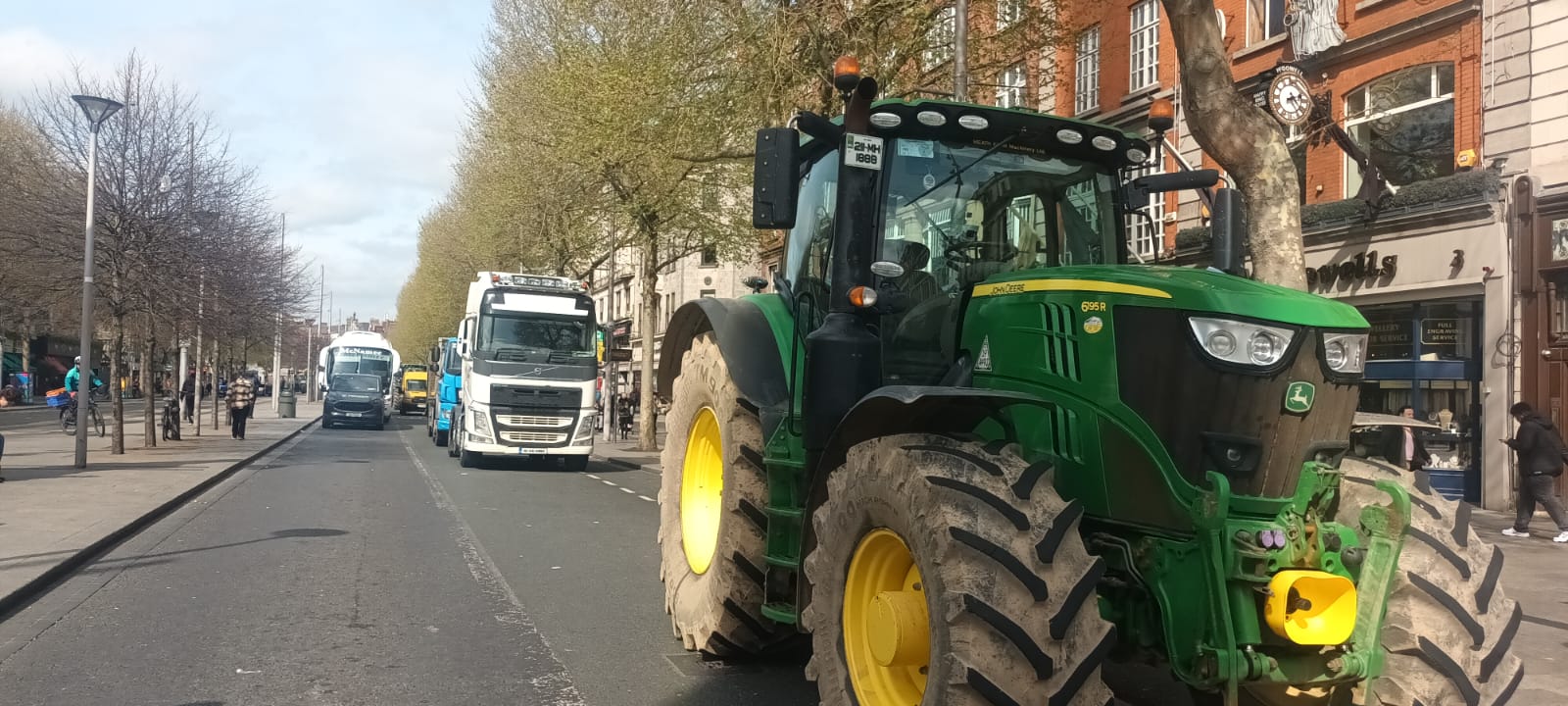
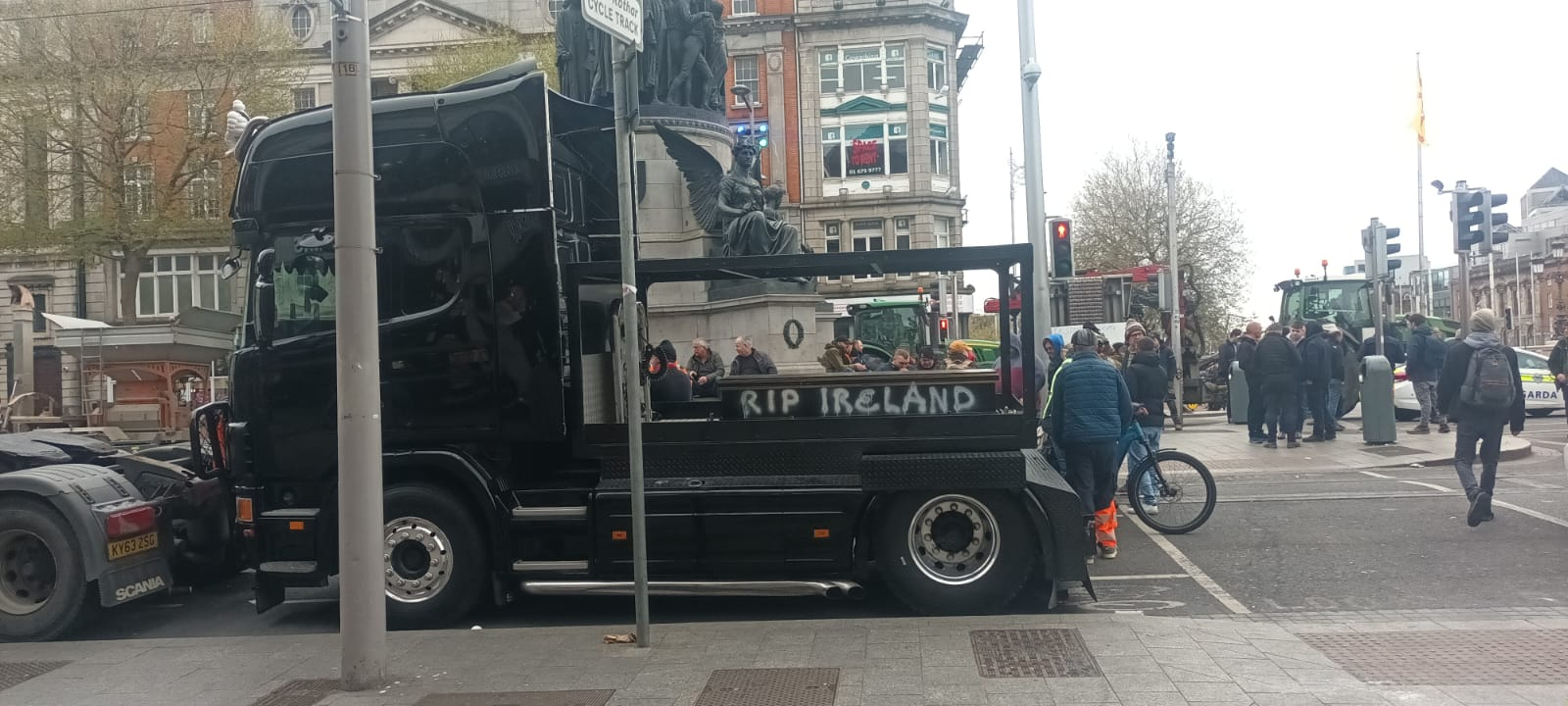
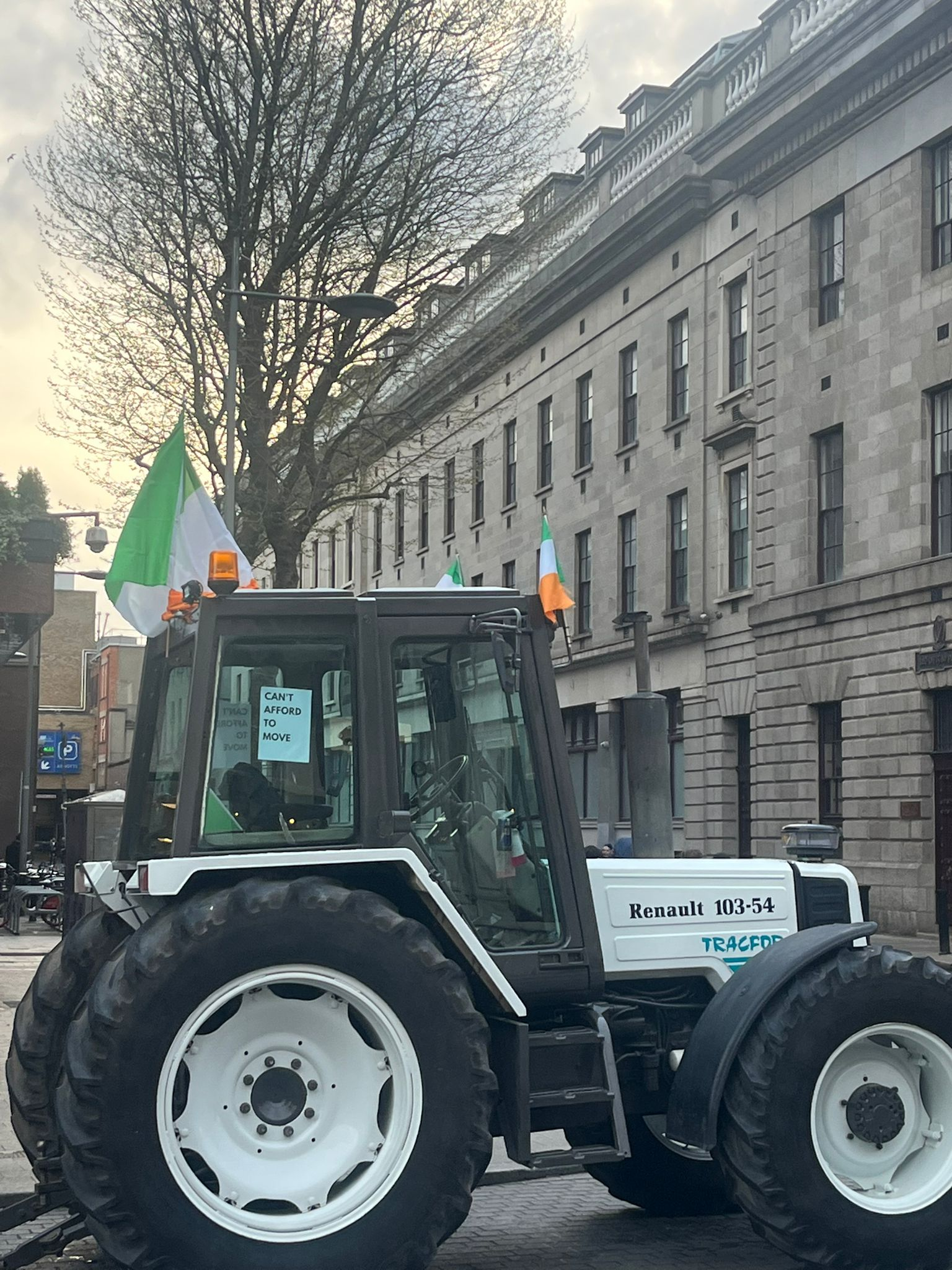
Dublin city centre was at a standstill for almost a week as farmers and hauliers who had been stretched beyond breaking point blocked the streets with their heavy vehicles. Farmers joked that they had done their friends in the Green Party a favour, having at last pedestrianised Dublin City centre.
Tractors and trucks bearing registration plates from all four provinces barred traffic from making its way down O’Connell Street. These tactics were repeated at ports and oil depots across the country, including Ireland’s only oil refinery, and by rolling blockades on major roads.
By taking matters directly into their own hands protesters were able to wrestle €500 million in concessions from the government. The example has now been set. As the cost-of-living crisis threatens to escalate once again, workers and youth will remember how militant struggle was able to win a partial but notable victory.
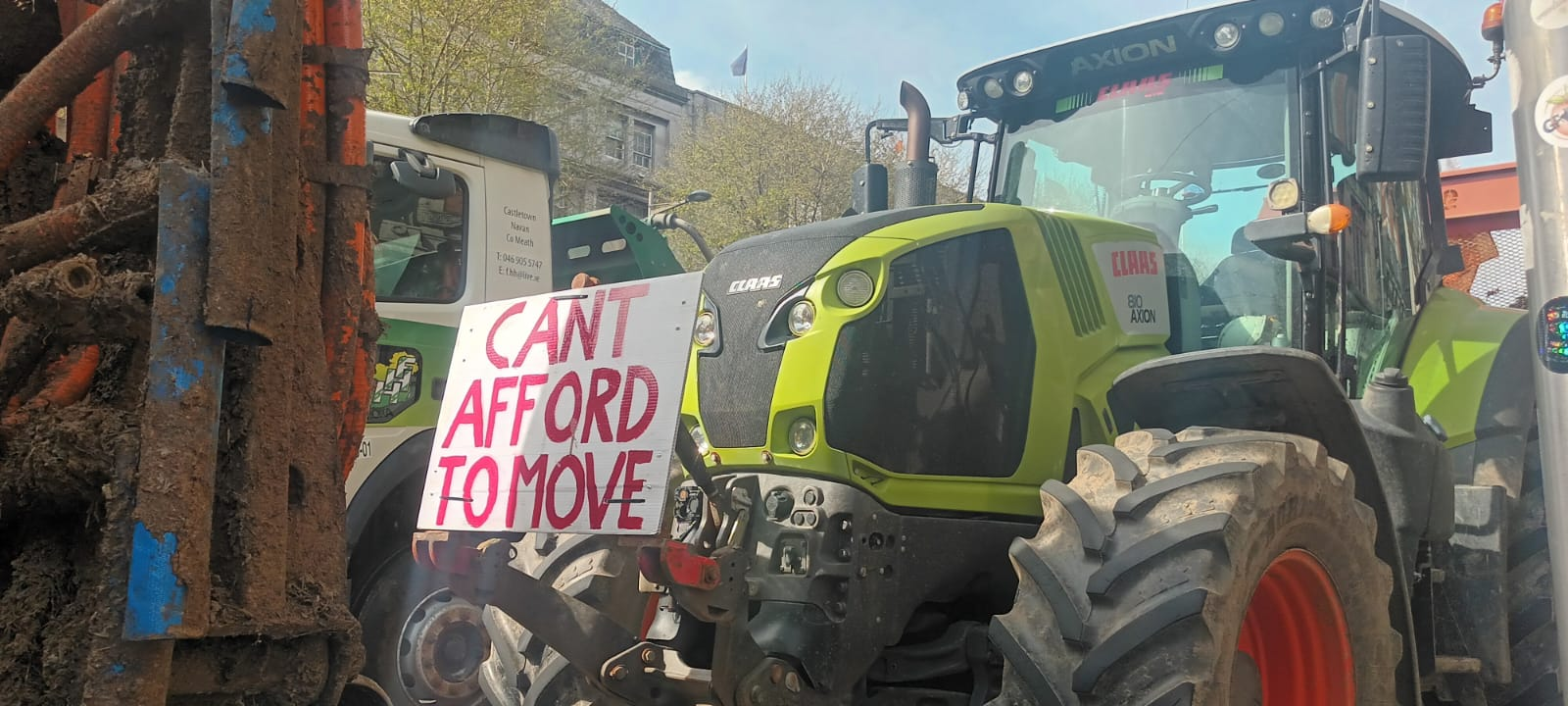
“Can’t Afford to Move”
Through the fuel protests, the anger of farmers, hauliers, other small business owners – and their workers – spontaneously erupted onto the scene.
The immediate reason for the protests was the spike in fuel prices that followed Trump’s war on Iran. Green diesel – used in farming and construction– almost doubled in price from €0.97 per litre to €1.75. Petrol and diesel also jumped from around €1.70 per litre to €1.90 and €2.10 respectively, putting the squeeze on haulage companies.
The government’s initial €250 million support package removed 15-20 cent excise taxes on petrol and diesel, but offered only a miserly three-cent reduction for green diesel – “a kick in the teeth to the contractors and the farmers,” as one agricultural contractor put it. Worse still, despite the tax cuts, prices at fuel pumps quickly returned to pre-package levels.
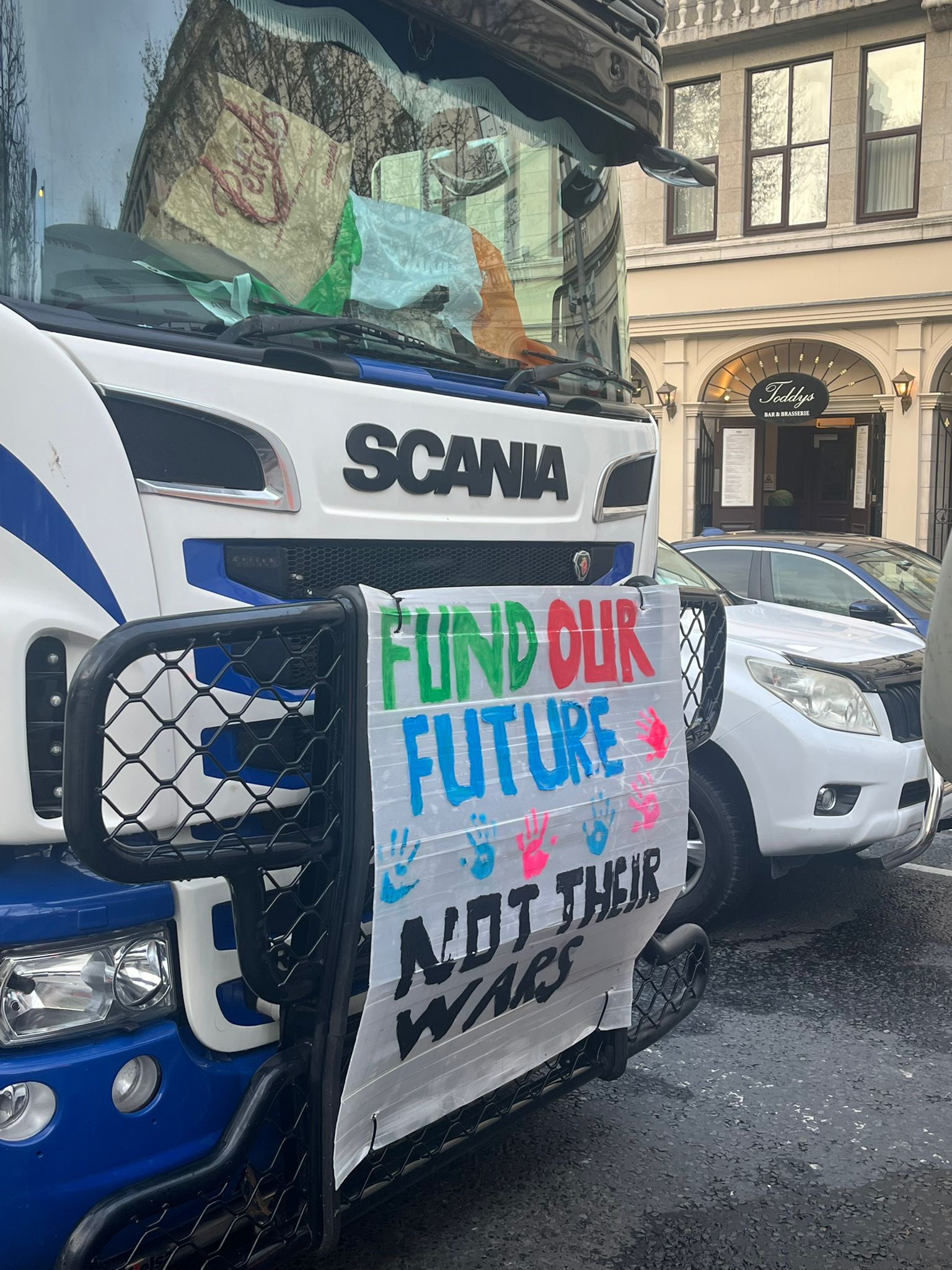
Faced with the real prospect of financial ruin, protesters refused to wait. Anger burst forth in the form of blockades and found its voice with slogans such as “can’t afford to move”, “taxed to extinction,” “no farmers, no food” and “fund our future not their wars”.
Government response
Rather than seeking to address the protesters’ grievances, the government dug in its heels. It refused to meet for negotiations and moved quickly onto the offensive – combining repression on the ground with a campaign to undermine and discredit the protests.
No efforts were spared in slandering and discrediting those who were involved. By literary alchemy the media attempted to transform the blockades into the cradle of Ireland’s far-right movement – and a deeply sexist one at that.
Of course no one denies the presence of right-wing agitators at the protests in Dublin. But those making such a great deal of noise about them are only hellbent on dragging the ordinary protesters through the mud and diverting attention from their legitimate grievances.
Tánaiste Simon Harris even had the cheek to come out expressing his ‘alarm’ that “some people” would decide who could go where and access hospitals. As if he, and the coalition government he is part of, are not the ones responsible for the never-ending hospital waiting lists!
The entirety of An Garda Síochána was mobilised against the protests. The government even called in the army to help break up the blockades. Pepper spray was paired with threats of towing, arrests and the seizure of vehicles.
Even when negotiations did take place, the government made sure of keeping the protesters out, and instead dealt with their so-called ‘representatives’ of the Irish Farmers’ Association (IFA) and Irish Road Haulage Association (IRHA). Once a deal was reached the government announced that the terms would not be revealed until after the blockades had ended.
By 14 April, after a mix of concessions and repression, the protests had mostly wound down. The government was forced to concede an additional €505 million in fuel subsidies. These concessions, so Simon Harris expects us to believe, came as “solely the outcome” of the negotiations. It is clear to everyone that it was in fact the protests which forced the government’s hand.
Militancy wins – lessons for the labour movement
But why has the government taken such a hostile stance towards the protests, when they are apparently awash with cash, and when small business owners, farmers, hauliers etc. would be their traditional constituency?
The problem for the government coalition is not in fact economic, but mainly political. The fuel protests have served as a point of reference and inspiration for workers struggling with prices at petrol pumps and on supermarket shelves. Despite the campaign of slanders and misinformation, and despite the disruption they caused to people’s daily lives, the protests maintained more than 50 percent support. Appetite comes with eating – Fianna Fáil and Fine Gael are afraid of the example the fuel protest could be setting.
In fact, this crisis could not have come at a worse moment for the government. Public sector pay is due to be renegotiated in June and 80 percent of public sector workers are already saying they have had to cut back on essentials. The trade union leadership will come under growing pressure from the rank and file to deliver.
If a few hundred farmers and hauliers employing militant methods can wrest significant concessions from the government, then what would be possible if the Irish Congress of Trade Unions (ICTU) – representing over 600,000 workers in the 26 counties – were to lead such a militant struggle? Such a force would be powerful enough to place any demand on the government – and to force its resignation if it won’t acquiesce. They could paralyse the country, and as the fuel protests have demonstrated, thirst for such militant action runs deep among workers and youth.
But it seems that this is far from the thinking of the bureaucrats sitting at the top of ICTU. During the protests Owen Reidy, the General Secretary of ICTU, came out swinging… against the protests:
“I’ve been involved in many public transport disputes over the years, and we have to ballot our members for industrial action, serve seven days notice, and ultimately, if we don’t do that, the High Court can injunct the disputes and sequester the union’s funds, but it seems farmers and businesses […] can do as they please.”
In other words, far from taking their example from the fuel protests, and replicating their militant methods to improve the lot of the working class that these union leaders supposedly represent, they are criticising the government for giving in!
The message they are sending to Fianna Fáil and Fine Gael is clear: ‘Hey, these guys are not playing by the rules, and you give them concessions – what are you doing, you are undermining our position as responsible negotiators! You are exposing social partnership for the scam that it is’.
Speakers on one of The Irish Times podcasts explained the significance of this well:
“Part of what we’re seeing I think is a wholesale rejection […] of that whole system of brokered dealmaking. And the whole Irish system of social partnership that goes back decades. Which is one of the reasons why the coalition was so nervous about the idea that they’d be interacting directly with the protesters […] by reaching outside, not only would they undermine the Road Haulage people and the IFA, but you can bet your bottom dollar as well that the unions and others were in their ears saying, ‘We’re all invested in this system that knits together from time to time. We all take pot shots at each other and criticise each other but ultimately at the end of the day some kind of fudgy consensus emerges.’ And that’s why I think this is a particularly interesting political moment and potentially a threat to that. Because it’s a wholesale rejection not only of the outputs of that system but in many ways of that system itself.”
Here it is straight from a mouthpiece of the Irish establishment.
The government’s ‘social partners’ in the trade union leadership, far from being interested in providing a militant leadership for the workers they supposedly ‘represent’, work instead to hold back the working class from entering into struggle. And they now fear that the government, by conceding to the farmers, will have undermined this very comfortable setup.
The union leaders see their role as that of the ‘respectable’ labour lieutenants of capital, holding back the working class… and are angry at the government for making their job in that regard harder. This is written in black and white in the statement released by ICTU commenting on the precedent set by the fuel tax cut:
“Trade unions across Ireland have taken note of events over the past week. While we are told the importance of being reasonable with pay demands, blockades and barricades have been rewarded with a €500m package of tax breaks. The Government has repeatedly indulged business interests, and shown a willingness to rely on the public purse to do so […]
“We will continue to make the case for progressive, substantial responses that will benefit those who need it, not just those who shout loudest.
“The Government has demonstrated, repeatedly, that the loudest lobby wins and that working people, who engage in good faith through proper structures, are rewarded with less than those who disrupt.
“A Government that can find €500m for one industry at the drop of a hat has no credible case to make for restraint at the pay talks table. The Government has set a clear precedent. Workers will remember it.”
This is a warning to the government. By refusing to give reforms at the behest of the meek, mild, peaceful and non-disruptive trade union bureaucrats, and instead giving into the ‘barricades’, ‘blockades’ and ‘loud’ direct action of the farmers and hauliers, the government has put the ladies and gentlemen of the trade union bureaucracy in a tough position.
Now the trade union leadership won’t be able to so easily justify their “reasonable” methods and “pay demands” in the face of workers who “will remember” that militant struggle pays. In other words: ‘we might not be able to do our job: holding back workers’ anger. And that is your fault, not ours!’
The first shot of the class battles ahead
The figures that emerged as the most visible leaders of the protests were of a purely accidental nature. People like James Geoghegan and Chris Duffy were propelled to the fore because their uncompromising rhetoric struck a chord with the mood on the streets amid the lack of militant leadership from the farmers and hauliers organisations, the trade unions or the main parties of the left.
In fact, while the government and their ‘social partners’ emerged damaged from the protests, the opposition parties made little headway, if any. Only Independent Ireland might have benefited politically from these events. This is a mostly rural party that mixes demands about housing and infrastructure with right-populist rhetoric on immigration. It remains to be seen how much traction they can gain from the protests.
Meanwhile the self-proclaimed ‘united opposition’ – the loose alliance of virtually every parliamentary party nominally to the left of Fianna Fáil and Fine Gael – fractured abysmally in the face of its first serious political test. For the most part, their response ranged from more or less qualified support, to calls from Labour for the blockade to be lifted, and with the Greens openly calling for repression against the protests.
Sinn Féin, for their part, came out in support of the blockades (after some initial vacillation). However this support did not go further than statements and a motion of no-confidence which was bound to fail.
It’s worth noting that one week after the blockades were dismantled, the Irish Neutrality League (which includes Sinn Féin, the Social Democrats and PBP) organised an anti-war, pro-neutrality march in Dublin. Had the question of neutrality and imperialism been linked with the rising cost of fuel – a connection that some of the fuel protesters were already making organically and that is by contrast missing from the protest’s main call – and an effort to link to the fuel protests, this march could have connected with the mood on the blockades. It could have provided a channel to fight against the government, not at the next general election but here and now. Sinn Féin undoubtedly have the platform to make such a call, if they wanted to.
That Sinn Féin did not seriously push for this is unfortunately not surprising given they are determined to present themselves as a responsible political party. Last time, it was right at the peak of the cost-of-living crisis that their support skyrocketed to 35 percent at the opinion polls. So far, they have been unable to capitalise on the mounting anger of broader sections of society – still polling at around 22 percent, same as this time last year.
A separate discussion is needed for PBP, who came out in support of the protests, but who likewise have been unable to gain in support on the back of the cost-of-living crisis, despite the stagnation of the main left-wing parties.
Despite their undoubtedly honest intentions, we have to say this is at least in part a result of the party shaving off its revolutionary edges. Instead, we see them favouring broad (and largely illusory) parliamentary fronts, as we see with the so-called ‘united opposition’ of which PBP is the loudest advocate.
In fact, the whole fuel protest has shown what an illusion this ‘united opposition’ was in the first place. It was a mistake to imagine that any broad ‘unity’ could be achieved with these parties that are reformist at best, and could only have damaged PBP to link arms with hated former parties of government like Labour and the Greens. The only thing they managed to unite on was the selection of Catherine Connolly for the presidential elections – and only because Sinn Féin was too afraid to run a candidate, and the other parties were too small to do so.
The mood that the blockade have exposed is one of deep hatred for the government parties and everything they represent, and a thirst for militant action. The path to winning these layers is not for socialists to ally themselves with yesterday’s partners-in-austerity and provide these zombie parties with left cover (some of which were coming out explicitly for repression against a protest supported by the majority of workers and youth!), but precisely to stand apart by offering a fight against the entire rotten system.
A panicked piece in last week’s Irish Times read: “state’s authority will be challenged again. We need to be ready”. This much is true.
The Revolutionary Communists of Ireland are fighting to build a Bolshevik party based on the ideas of Marx, Engels, Lenin, Trotsky and James Connolly. We believe that only such a party can channel the anger and willingness to fight that were on display during the fuel protests to not only wrest concessions from the ruling class, but to kick Fianna Fáil and Fine Gael out, and fight to overthrow their entire capitalist system that creates endless wars for the benefit of the rich and powerful, while the rest of us are made to pay for them.
Building such a party is not easy, but there is no alternative to fight against this rotten system.