The tenth issue of the Revolutionary Communist is coming out this week! Read the editorial of this issue below, and set up a physical or digital subscription now. Or meet us at one of our regular stalls to buy a copy directly from our comrades. Every subscription and paper bought will help us strengthen the revolutionary press, produce more regular articles and analysis, and advance the fight for communism in Ireland!
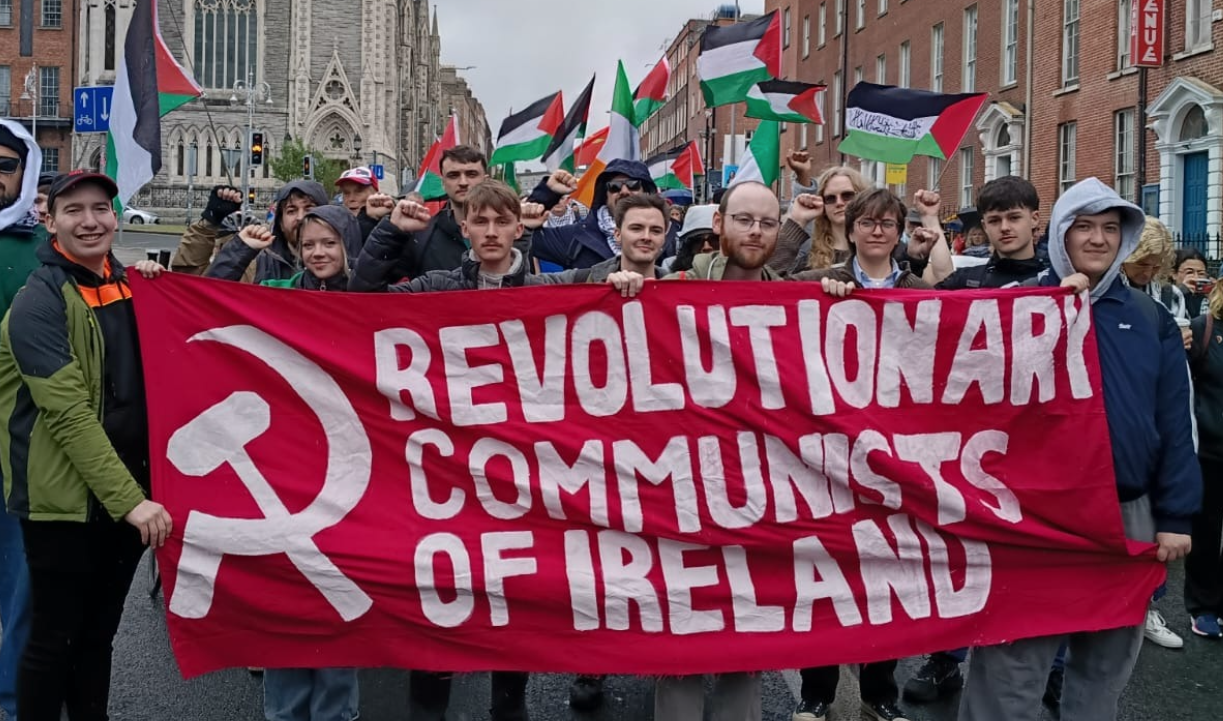
Over the weekend of 11-12 April, 70 communists from across Ireland gathered in Dublin for the Third National Congress of the Revolutionary Communists of Ireland.
Upon arriving in the Fair City, delegates were met with an almost surreal scene: dozens of tractors, trucks and buses blocked the city’s main thoroughfare as farmers and hauliers were locked in a militant conflict against the government over skyrocketing fuel prices. For almost a full week, anger, frustration and a willingness to fight hung thick in the air of Dublin. One could hardly imagine a more fitting setting for a communist congress to take place.
One could hardly imagine a more fitting setting for a communist congress to take place.
As the crisis of world capitalism deepens, pushing Irish capitalism – North and South – ever closer to the brink, the struggle unfolding in Dublin will be remembered as merely a prelude: a foretaste of the explosive class battles to come. The task now, as set by our Congress, is to build a strong revolutionary organisation in advance of the coming upheavals.
Crisis looms
The material to spark such upheavals is in fact piling up day after day.
At the time of writing we are in day 70 of Trump’s war of aggression against Iran – a war responsible for what the International Energy Agency has described as “the worst energy crisis in history”.
While it is unclear what happens next, more than two months of war have already had a severe impact on the capitalist economy. Bank of Ireland is now predicting a major “squeeze” on household incomes in 2026, and has warned of an “investor loss of confidence” reminiscent of the 2008 financial crash. Consumer confidence has meanwhile fallen to its lowest level since 2022.
All of this points towards the possibility of a new recession hitting the economy – something Bank of Ireland itself now considers a concrete possibility.
Indeed, a report drafted by the bank well before the first bombs fell on Tehran estimates a one-in-five chance of recession for the Irish economy in the short term. This includes a “severe but plausible” scenario in which both Ireland and Britain enter “deep recessions”, with unemployment surging above 11 percent by 2027. And what potential triggers does the report identify? The bursting of the AI bubble, the collapse of the private credit market, a major climate catastrophe, or the boiling over of international tensions…
A crisis – potentially of a scale not seen in decades – is steadily being prepared
And to be sure, we don’t need to wait for a recession to find scores of angry workers and youth. Already the establishment parties are more unpopular than at any point in their history.
According to the latest Red C opinion polls, Fianna Fáil and Fine Gael are now at 16 percent each – their lowest combined support ever recorded. To think that the two parties that held a ‘duopoly’ on Irish politics for over a century have already fallen another 11 percentage points since receiving their lowest ever combined vote at the last general election, is truly extraordinary.
But their ever-increasing unpopularity is not translating into support for the opposition. Sinn Féin remains stagnant in the low-to-mid 20s. In the absence of a genuine anti-establishment alternative, discontent is being expressed through all sorts of weird and wonderful outlets. At the time of writing, two weeks separate us from the by-elections in Galway West and Dublin Central – contests which already promise to deliver another humiliating blow to the establishment parties, but from which no alternative force commanding firm and enthusiastic support is emerging. And yet the widespread sympathy for the fuel protests reveals the enormous reservoir of anger and combativity that exists among broad layers of workers and youth. Sooner or later, that mood will once again erupt openly onto the scene.
Smash stormont
The situation facing the Six Counties is hardly better. On the contrary, alongside all the pressures building in the South, there is also the deep economic and political crisis facing Stormont.
The Assembly has not only been collapsed for almost half of its existence, not only has it failed to deliver anything meaningful during the current mandate, but it is now teetering on the edge of financial collapse – something that would have consequences nothing short of devastating for the already dilapidated public services and infrastructure of the North.
In a recent opinion poll conducted by Amárach Research, respondents in the North were asked whether they trusted the EU, the British government, the Irish government or the Stormont Executive the most. Only 5 percent selected the Executive! What a staggering crisis of legitimacy for the constitutional set-up of the region. But looking at the state of the North and the track record of the Executive, is it any wonder?
Meanwhile, with the next Assembly election ‘only’ a year away, the parties are already in full electoral mode. The DUP is engaging in constant baiting of the nationalists. The TUV bangs on about the Sea Border, attacks the DUP as traitors, and works relentlessly to raise the sectarian temperature within the Assembly. Whatever little illusions remained that Stormont could deliver some meaningful changes are getting smashed into a thousand pieces by reality.
Sinn Féin have led themselves into a blind alley. There was undoubtedly enthusiasm for the prospect of a nationalist First Minister, and they rode that wave to top the polls in 2020. But by playing the ‘responsible’ game in Stormont, Sinn Féin are pouring a bucket of cold water over the aspirations of working-class nationalists. Though still by far the most popular party in the North, they have lost six percentage points in the polls in recent months, and will struggle to inspire enthusiasm among many of its own supporters when the election comes.
In short, the political front is utterly blocked as an avenue for meaningful change. Inevitably this means that we will see rising militancy in the workplaces and on the streets. Only a few weeks ago, thousands marched through Belfast against one of the ugliest expressions of the crisis of capitalism in the Six Counties: the growing epidemic of femicide and violence against women.
Workers and youth in the North are desperately searching for a way out of the crisis. The urgent task of communists is to fight to build one.
Build the RCI
Our Third Congress gave us the opportunity to take stock of the last few years of activity. In four years, the RCI in Ireland went from a tiny group counting only a handful of members, to an organisation of more than 90 active revolutionary communists, organised in 13 branches across the country, with two-full timers, an office and a bi-monthly paper.
This however must be only the beginning.
Revolutionary events will hit Irish shores sooner than many realise. Revolutionary communists must rise to the occasion and build a force capable of waging a struggle to drive imperialism out of Ireland, overthrow capitalism, and build a 32-county socialist republic.