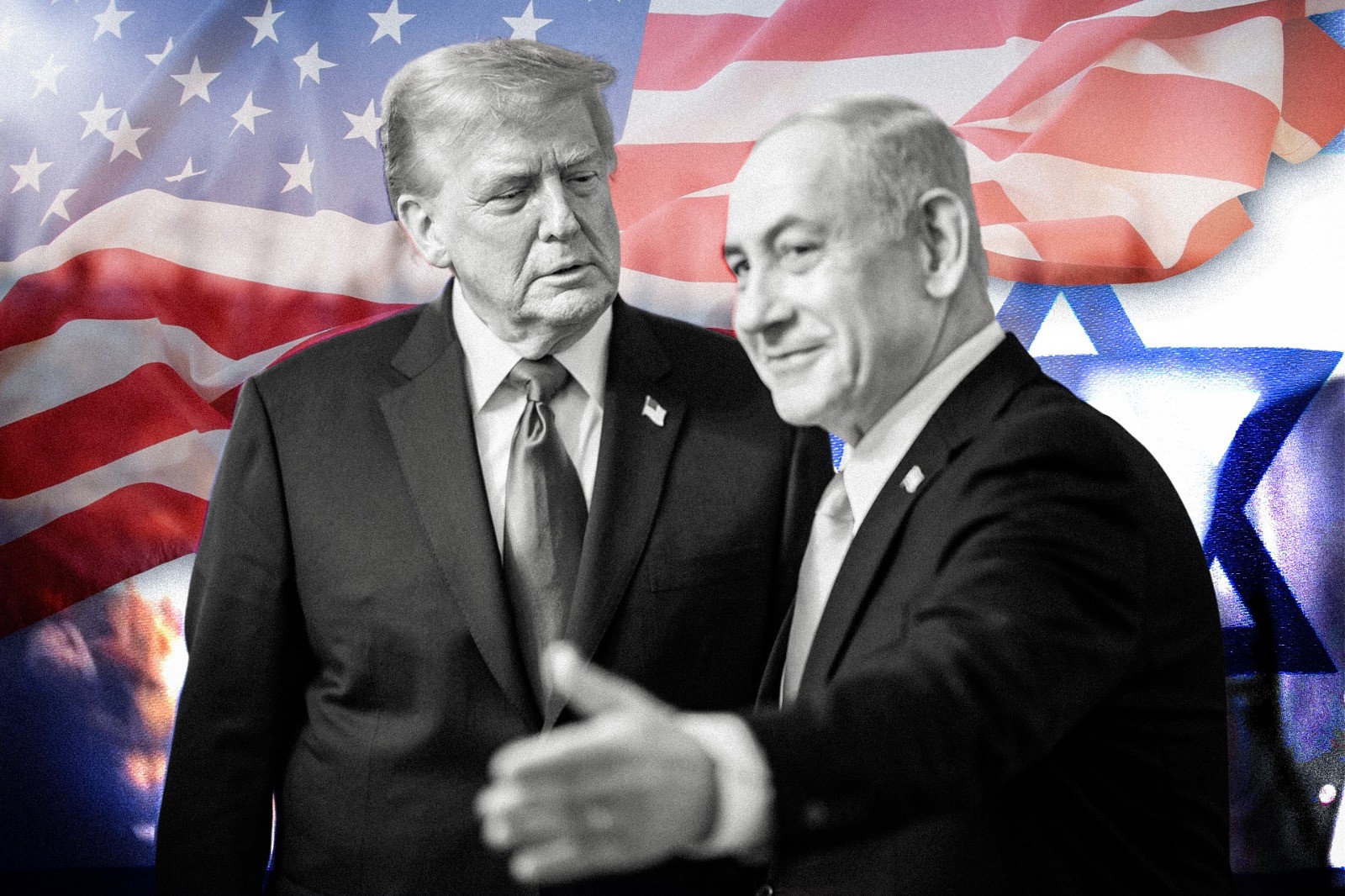
According to The New York Times, the war against Iran was hatched not in Washington, but in Jerusalem. It was Benjamin Netanyahu who formulated the plan, which he then brought to Trump and his cabinet for approval at a meeting in the White House in February.
Four months on and Trump is a desperate man. All the initially stated US war aims have been quietly shelved, and all Trump wants now is to save face and reopen the Strait of Hormuz.
Netanyahu has other ideas. His goals, quite distinct from those of the Americans, involve expanding Israeli-occupied territory, dismembering Iran, and above all, keeping the US in a drawn-out war. He is therefore attempting to collapse the ceasefire and to recommence hostilities by continuously provoking the Iranians in Lebanon.
“You’re fucking crazy,” Trump recently told Netanyahu directly over the phone, “You’d be in prison if it weren’t for me. I’m saving your ass. Everybody hates you now. Everybody hates Israel because of this.”
And yet, the ceasefire looks increasingly fragile. Trump is unable to force Iran to accept any position that doesn’t look like a surrender on Trump’s part. And therefore, Netanyahu may get his way over Trump. After the latest exchange between Iran and Israel, Trump angrily reprimanded Netanyahu for firing at Iran. “I call the shots,” he unconvincingly reminded him.
Since 7 October 2023, Israel has seemingly set the tempo of events, waging war on seven fronts, while the US has seemingly allowed itself to be led. A continent-spanning nation of 350 million is being led along a course that is proving hugely detrimental to its interests by a little nation of less than 10 million inhabitants, occupying a small area of land 9,000km away.
This appearance of Israel dictating to America has given grist to the mill of antisemitic conspiracy theorists. However, this strange relationship does deserve an explanation, which, it turns out, is much simpler than a conspiracy.
[Originally published at Marxist.com]
The origins of the US-Israel relationship
The US-Israel relationship began developing in the postwar period. At the time, the Middle East was emerging as a key region for the United States, which was rising to the status of the world capitalist superpower.
Why is the Middle East so important? Oil certainly played a role. By 1970, US crude oil production had peaked, and thereafter fell off. Meanwhile, the prolonged industrial boom of the postwar period led to ever rising US demand for Gulf oil.
But oil is only part of the equation. A no less important factor was the US ruling class’ fear of communism. Given its proximity to the Soviet Union and the revolutionary convulsions that swept the region from the 1950s, the Middle East was a front line in the Cold War.
Today, US imperialism and Israel are so intertwined that it might be tempting to imagine that they always had this relationship; that Israel originated as a bridgehead for US interests in the region from day one. But that is not how things actually unfolded.
So how did the US-Israel relationship evolve?
In 1948, at the time of the Nakba, the primary aim of ascendent US imperialism was to supplant the influence of declining Britain from the Middle East.
The British upheld their domination mainly through the agency of a string of reactionary monarchies. The establishment of Israel worked nicely for the Americans – it weakened Britain. President Truman was therefore quick to recognise the state of Israel.
However, US imperialism didn’t just want to weaken the British Empire. It wanted to take over the whole franchise, which meant shepherding the reactionary Arab monarchies into its own orbit. The Americans were therefore careful not to inflame Arab public opinion against themselves at this stage by being overly zealous for the new state of Israel, which had established itself through terror and the ethnic cleansing of Arabs.
As we’ve discussed elsewhere, the US did support Israel, but largely indirectly, primarily through West German reparations and through the private assistance of Jewish American capitalists.
But in the 1950s, US policy faced a new challenge. The reactionary Arab monarchies were falling like dominos across the region as radical Arab nationalist officers leaned on the masses to launch coups, starting with the Free Officers’ coup in Egypt in 1952.
Even here, faced with something new, the strategists of US imperialism felt their way empirically. After all, Egypt’s King Farouk had been a British, not an American stooge. Perhaps the Americans could work with Nasser?
Thus, in 1956, when Nasser nationalised the Suez Canal – and the Israelis, British and French occupied the Sinai Peninsula in response – President Eisenhower angrily demanded their withdrawal.
Could anyone imagine a US president taking such a stance with Israel today? One could certainly imagine such demands being placed on Britain and France, but not Israel!
The fallout of the Suez Crisis jeopardised Israel’s relations with the US for a decade. It is not by chance that Israel developed its own nuclear programme in the 1950s and 1960s, behind the backs of the US, in secret collaboration with French imperialism.
However, this US policy soon went awry. Egypt, from balancing between the great powers, started to lean increasingly towards the Soviets, from whom they began receiving weapons in quantity. Syria began leaning in the same direction. Then in 1958, revolution erupted in Iraq, and the Hashemite monarchy was overthrown, there too replaced by nationalist officers keen to emulate Nasser.
US policy had to adapt. In the late 1950s, the President announced his eponymous ‘Eisenhower doctrine’: the US would intervene anywhere it felt necessary to ‘contain communism’, which it did in Jordan and Lebanon.
The mask was cast aside. US imperialism came out openly as an aggressive imperialist power in the region that was willing to intervene militarily to defend its interests.
After the Six Day War: Israel, the ‘unsinkable aircraft carrier’
The problem was that the US was preoccupied in Vietnam. What the Americans needed above all in the Middle East was a powerful, armed proxy that it could work through. It was in this context that Kennedy signed the first major military deal directly with Israel in 1963.
But the real turning point in the US-Israel relationship came in 1967 with Israel’s victory in the Six Day War.
In a stunning preemptive attack, Israel destroyed the entire Egyptian airforce before it could get off the ground. From there, they rapidly seized the West Bank from Jordan, the Golan Heights from Syria, and not just Gaza but the whole Sinai Peninsula up to the Suez Canal from Egypt.
The US ruling class was ecstatic. At a stroke, two of the USSR’s main allies in the region (Egypt and Syria) suffered a heavy blow, without the involvement of a single US soldier. From this point on, money, arms and intelligence began flowing in Israel’s direction.
Since then, Israel has received more than $330 billion in aid, adjusted for inflation. The US built it up economically and militarily into a regional superpower: a powerful little Sparta that could fight on America’s behalf.
Its military spending figures paint a vivid picture of Israel’s warped, militarised economy. Until 1967, this spending remained below 10 percent of GDP – still high by most standards. Then, in 1967, it shot up to over 15 percent and continued ascending. Military spending peaked at over 30 percent(!) of GDP in 1975, never dropping below 15 percent until 1986.
In the whole period from 1967 to the end of the Cold War, Israel was an armed camp, propped up by US dollars. It became “the largest unsinkable American aircraft carrier in the world,” to quote the words of US General Alexander Haig.
In return for this support, the Israelis have repaid their American benefactors many times over.
Israel’s victory in the Six Day War – and subsequent wars in the early 1970s – led almost directly, after Nasser’s death in 1970, to Egypt’s return to the US sphere of influence under Sadat.
In Syria too, defeat helped bring about the downfall of the left-wing Ba’athist officers and gave the ascendancy to right-wing elements under Hafez al-Assad in 1970, who initiated the infitah (opening up), which began the process of restoring capitalism.
No wonder Israel was so admired by its backers, the American and western capitalist classes.
The threads binding the two became stronger and more numerous. Israel attracted western capital investment. Israel’s tech sector today is world-leading in cybersecurity and AI drone and robotic technology, all thanks to the privileged relationship that it enjoys with the US military-industrial complex, of which it is a valuable adjunct.
And its relationship is indeed privileged. Not only does Israel receive the most US military aid in the world, it is the only country which the US allows to use its military aid to prop up its own domestic arms industry rather than buying American.
Meanwhile, Mossad came to form a key link in US intelligence. US General John Keegan described Israel’s intelligence contribution to the US as “equivalent to five CIAs”.
In its many wars, Israel captured huge amounts of Soviet equipment and weaponry that allowed the US to keep an edge in the arms race. It helped the US get its hands on Soviet radar, tanks, and even fighter jets. In one case, Mossad even induced an Iraqi pilot to fly a Soviet MiG straight to Israel.
We could go on, but the point has been made.
Considering the service that Israel has rendered to US imperialism, the value it has acquired, it is little wonder that it has captivated the hearts and minds of the US ruling class over so many decades. Support for this small nation has become a bipartisan article of faith.
Its most avid supporters have formed a powerful lobby – the most powerful lobby in US politics. As well as comprising many Jewish American capitalists and the establishment in the Jewish community, the Israel lobby also comprises an equally powerful evangelical Christian Zionist component.
They’ve worked together to foster cultural, economic and political links, to silence anti-Zionists, and above all to ensure the most pro-Israel line possible in Washington. They have sought to tightly weld the destinies of these two countries to one another.
But we should emphasise: the rise of the Israel lobby is hardly the cause of this special relationship but rather its outcome. The affinity of the US ruling class for Israel no more needs the Israel lobby as an explanation than its hostility for the Cuban Revolution requires the Cuban gusano lobby as an explanation.
But even when the actions of Israel, to an objective observer, are patently detrimental to the interests of US imperialism, what do we see? This powerful body of opinion in the US ruling class, this instinct, urged on by the Israel lobby, keeps it moving in lockstep with Israel, even as the two diverge. There are limits to all things, however.
Israel has its own interests
The Israeli ruling class has always had its own separate interests, very much apart from those of the US. And they have been far less shy about defying their benefactors when it comes to asserting those interests than the US has been in defying Israel!
Where do the Israelis get their defiant streak? The calculation of the Israeli ruling class is simple. For US imperialism, its relationship with Israel is all or nothing. Either Israel maintains military superiority in the region, or it does not.
The Americans may complain at the actions of the Israeli government, they may temporarily pause weapon shipments, but government after government in Israel has always calculated that they will ultimately come down on their side.
Thus, the Israeli ruling class has aggressively pushed its own interests, on many occasions in direct defiance of US presidents. This has included even openly hostile acts against the US itself, including committing industrial espionage and stealing nuclear secrets, as well as simply carrying its own expansionist agenda further than US presidents would like.
In the 1980s, Reagan – who was pro-Israeli even by the standards of US presidents – was stunned that the Israelis went ahead and bombed Iraq’s Osirak nuclear power plant in 1981 without even giving the US forewarning. He was tearing his hair out again when the Israelis began bombing Beirut in 1982.
He even called Israeli Prime Minister Begin, whose forces were then bearing down on Beirut, and accused him of committing a “holocaust”! Strong words indeed for a US president, only recently superseded by Trump’s expletive-laden tirade against Netanyahu, as the latter threatens Beirut.
Ultimately though, Reagan backed every one of Israel’s horrific crimes in Lebanon. More than that, he was the president who most thoroughly cemented the ‘special relationship’ with Israel. He defined new, unique levels of strategic and military partnership, with all the many privileges that flowed from it for Israel, and even bailed Israel out financially when its enormously distorted militarised economy succumbed to hyperinflation and a banking collapse in 1985.
This is the story all along the line:
- Israeli prime ministers do as they wish;
- American presidents grumble;
- Israel gets its way.
Just as this unique ‘special relationship’ has fostered fanatical loyalty towards Israel in the US ruling class that has continued long past the point where it has ceased to be rational, so too has it warped the psychology of the Israeli ruling class, epitomised above all by Benjamin Netanyahu, who has dominated Israeli politics since the 1990s.
The vicious little bully on the playground goes around confidently harassing the other kids because he feels he’s got the big bully on his side.
In leaked footage from 2001, Netanyahu smugly explains to journalists how he went about undermining the Oslo Accords. To the question of whether he’s worried about angering the Americans, he replied: “I know what America is. America is a thing you can move very easily”.
The Israeli ruling class senses that it has the full force of the most powerful empire on Earth behind it, and it has become accustomed to turning that support on and off like a tap.
The psychology of the US ruling class
Here is perhaps the pertinent question, however: the United States did have an interest in building up Israel as this little Sparta. But the Cold War is over. Meanwhile, shale oil means that the US, far from relying on Gulf oil, is now one of the world’s top exporters.
American interests have moved on. So why has the American ruling class not also moved on? Its love affair with Israel continues.
The consciousness of classes does not immediately develop in lock step with events. And the consciousness of the American ruling class has been moulded into what it is by eight decades of untrammelled dominance.
The establishment in the US – neocon Republican and liberal Democrat – shares a fundamentally unified view. One argues that untrammelled American strength brings with it ‘security’ and ‘prosperity’; the other argues that the US is duty-bound to uphold the world ‘rules based order’.
Both amount to the same thing: America can and must assert itself everywhere; America can and must remain the world hegemon. It is almost a subjectivist, postmodern worldview. If America wants it, it can have it. It is just a matter of will, never mind the reality!
These are the people calling the shots, who are working hand in glove with Israel right now to collapse the ceasefire with Iran, insane though that is. They live in another world from the rest of us, one where they can do what they want, and where Israel is their reliable, “unsinkable aircraft carrier” rather than a crisis-ridden liability.
And Trump too is living in the past. Consider Iran. Which American citizen knew where Kharg Island was before the war broke out in February? Trump knew. As early as 1988 he had said that if he was president, he would “do a number on Kharg Island.”
The whole American ruling class has long known exactly where Kharg Island was. The US ruling class isn’t accustomed to being humiliated, and where it suffers humiliation, it broods over it. The humiliation they suffered in Iran back in 1979 – with the establishment of the Islamic Republic in Iran, and the US embassy hostage crisis – has played on their minds for decades.
Reason has very little to do with their policy. The ‘reasonable’ thing for the Americans to do right now would be to acknowledge their defeat and negotiate their withdrawal from the war. This would mean acknowledging Iranian control of the Strait of Hormuz, and a much diminished status for the US in the region.
But the US ruling class cannot conceive of a world where its power is limited. Even the idea of negotiations seems to be alien to the US ruling class. America doesn’t negotiate. Negotiation means compromise. If America wants something, it bullies and intimidates and it takes it.
Thus the ‘negotiations’ that preceded this war were no negotiations at all. They were just a means to buy time while military hardware was moved into the region. Iranian negotiators were still at the negotiating table in Oman when America attempted to decapitate the regime.
We might add, the negotiations carried out by the Americans with the Russians over Ukraine have been just as unserious, reflecting the same fundamental psychology.
A tipping point
This is how things have been for decades. But all things must eventually reach a limit. Eventually, quantity must transform into quality. Firstly, America’s embrace has moulded Israel into a society which is now being torn apart by its own internal contradictions.
On the one hand, Israel flaunts itself as the Middle East’s ‘only democracy’. On the other hand, the level of legally sanctioned discrimination against Palestinians embedded in Israel’s laws makes a mockery of such a claim, while the 2017 Nation State Law officially defines non-Jews as second-class citizens.
On the one hand, it is home to some of the most advanced high-tech industries in the world. On the other, it has cultivated an enormous mob of fanatical settlers who believe in the literal truth of the Torah.
On the one hand, Israel has the most ‘unicorns’ (companies worth over $1 billion) relative to GDP of any country in the world. On the other hand, it has some of the worst poverty levels in the OECD.
Just six months before 7 October 2023, all these contradictions exploded to the surface. Israel was racked by enormous protests, ‘general strikes’ and civil disobedience. The ruling class was at war with itself.
Netanyahu has successfully plastered over these contradictions with one war after another, starting in Gaza. In doing so, he has delayed the day of reckoning by raising the contradictions in Israeli society to the nth degree.
This is a small country. After three years of continuous war by a conscript army, discipline is apparently breaking down inside the occupation forces in Lebanon. More than half of reservists are failing to respond when called up by the IDF. 63 percent of officers want to quit the military.
Economic troubles loom. Tech start ups are in disarray. An important working-age cohort is in the army. Mental health problems are at epidemic levels. Above all, Israel has suffered an enormous psychological blow. The image that the ruling class had fostered, that Israel is an invincible force, has been shattered. The Zionist state can no longer claim to live up to its own justification for its existence: that it can guarantee the safety of the Jewish inhabitants of Israel.
At each stage, Netanyahu has upped the ante to keep his government together and to save his own skin. So far he has succeeded. But the contradictions inside Israel have repeatedly threatened to reemerge, each time more violently – as we’ve seen with the anger directed at Netanyahu from the families of the hostages, as well as from Ultra-Orthodox Jews when threatened with losing their immunity to conscription.
All this will eventually reach its limit.
The future of the US-Israel relationship
But things must also reach their limit for the US-Israel relationship. The events of the past three years are profoundly undermining support for Israel inside the US.
Before 7 October 2023, a majority of Americans sympathised with Israel (54 percent) over Palestine (31 percent). That is how things had remained for decades.
Today, fewer Americans support Israel (35 percent) than support Palestine (41 percent). Among young people the figures are even more striking. A wide majority support Palestine (53 percent) as against Israel (31 percent).
These are unprecedented shifts in the consciousness of the American public. In the words of Democratic Party Congressman Ro Khanna, “I’ve never seen public opinion change as fast on any issue, including gay marriage […] as it has on the U.S.-Israel relationship.”
The Democrats are feeling the pressure. Money from the Israel lobby group AIPAC has become the kiss of death for some Democrat politicians, to the point where it has been revealed that AIPAC has resorted to obscure backchannel funding to avoid identification. Republicans are also feeling the pressure. The MAGA base is also being split over this question, with figures like Tucker Carlson accusing Trump of swinging from ‘America First’ to ‘Israel First’.
Is it possible, despite everything, to imagine a break between Israel and the US at a certain point? Notwithstanding the place Israel occupies in the psychology of US imperialism, there is another consideration, which we’ll attempt to illustrate with a little analogy.
Before the decline of US imperialism began, before it was the world’s hegemon, there was British imperialism.
After the First World War, Ronald Storrs was imposed by the British as the Military Governor of Jerusalem just as it was taking over Palestine as the new colonial master. It amused him to refer to himself as “the first military governor of Jerusalem since Pontius Pilate”. The British encouraged Jewish migration, and encouraged division between Arabs and Jews.
In his autobiography, written before the founding of Israel, Storrs explained that the idea had occurred to the British imperialists of creating for themselves a “little loyal Jewish Ulster in a sea of potentially hostile Arabism”. Just as Catholic Ireland was planted with Protestants in the 17th century in an attempt to assure a garrison for British interests, so imperialists like Storrs imagined the Jews playing a similar role among the Arabs.
A ‘little loyal Jewish Ulster’ essentially came to pass, except loyal to the Americans rather than the British.
There may be some parallels with the Middle East and Ireland. As British imperialism went into decline, as its empire fell apart, its interests also changed in Ireland. By the postwar period, the North of Ireland had deindustrialised and there was little need for a permanent presence to ward off threats from European rivals to Britain’s west coast – Britain and its rivals alike had been turned into little American vassals.
So Britain no longer had an interest in maintaining the partition of Ireland. Its ‘loyal Ulster’ had served its role. Except, the British had created a Frankenstein’s monster. Ulster loyalism didn’t just go quietly into the history books. It continued to whip up chaos, to persecute Catholics. It produced monsters like the Rev. Ian Paisley, with his sermons against popery.
By the late 1960s, these contradictions threatened to explode into civil war. Whatever the British may have wanted – and it may have been in their interests at that time to ‘let go’ of the North of Ireland – they were prisoners of their past policy. They could not let go. They were drawn in more than ever before.
British troops were sent onto the streets of Ireland and tied down for decades, while bombing came to the British mainland. Even today, the North of Ireland continues to create problems for much diminished British capitalism. Just look at the pogrom we’ve seen in the past week.
Like a spider trapped in its own web, British imperialism became trapped in the contradictions it had woven in the past, that once served its interests, but from which it could no longer escape.
The American imperialists have done the same thing on an altogether more massive scale, entangling the whole Middle East, creating a ‘little loyal Ulster’ with expansionist ambitions and nuclear arms. Even if they were capable of soberly looking reality in the face – and they show no sign of being able to – they would be unable to extricate themselves from this mess, which is becoming a big factor in accelerating their decline.