The latest LucidTalk poll has sent shockwaves through the political establishment in the North. The three parties that came out on top in the last Stormont elections are now all but bleeding support.
Jeffrey Donaldson’s conviction for child rape and abuse has plunged the DUP into crisis. Alliance is now polling at its lowest in eight years. And then there is Sinn Féin. While still comfortably ahead, the party has hit its lowest level in more than a decade. In two years, a quarter of its support has evaporated.
This is a drop almost comparable to that suffered by the DUP over the same period – and yet Sinn Féin’s former leader is not a convicted paedophile… So, what is happening to Sinn Féin?
First Minister
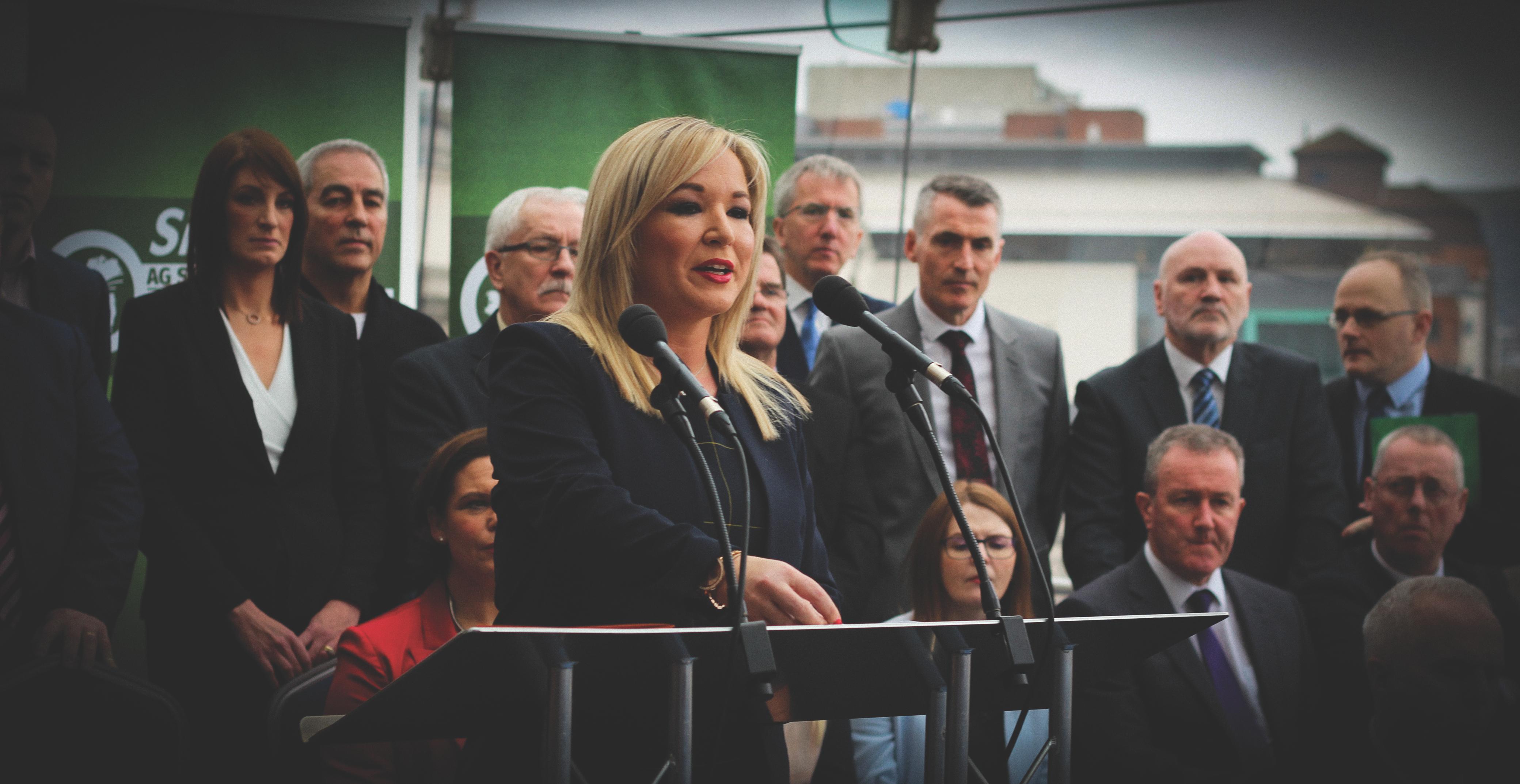
It is only a little over two years since Michelle O’Neill first walked up the steps of Stormont as a nationalist First Minister – an historic first for a statelet intentionally carved out of Ireland to ensure a permanent Unionist majority. “That state is now gone,” O’Neill proudly announced, speaking of a “new dawn” for the region.
Yet, truth be told, the effects of this new dawn have been underwhelming, to say the least.
We do not need to rehearse the Executive’s litany of failures here – they are plain to see for anyone with eyes. But, to give just a few examples, the Programme for Government identified several areas that “matter most” – including healthcare, social housing, violence against women, and the environment.
Well, since 2023, outpatient waiting lists have grown by almost 20 percent. More than 50,000 households are now on the social housing waiting list. And we were tragically reminded of the crisis of violence against women earlier this year with the murder of Amy Doherty. Meanwhile, Lough Neagh continues to be choked by toxic blue-green algae.
Then – even closer to home for Sinn Féin – there is Casement Park. O’Neill promised it would finally be redeveloped under her watch. Just a few weeks ago, it was revealed that the original plans for a state-of-the-art stadium had been thrown in the bin. If and when work finally begins, it will be for a stadium that won’t even be capable of hosting Ulster provincial GAA finals.
For the time being, the abandoned site in the heart of West Belfast stands as an open wound – exposing the inability of Sinn Féin to obtain anything meaningful even in the heartland of their own support.
Ballot box
Undoubtedly, the inauguration of a Sinn Féin First Minister was met with enthusiasm among nationalists. It seemed that Sinn Féin’s ‘ballot box’ strategy was finally paying off. But looking at the state of working-class nationalist areas today, it’s impossible not to wonder: what has it all been for?
Of course, the blame for the terrible austerity inflicted upon the North – and for the blatantly sectarian barriers still constantly erected against nationalist areas – lies first and foremost with Westminister and political Unionism.
As the latest reminder of this, just weeks after being sworn in as Prime Minister, Andy Burnham, in an outrageous display of colonial arrogance, declared that a border poll was “off the table”
But Sinn Féin have willingly put themselves in this position. For decades, they have willingly whipped up illusions that taking control of Stormont could bring about fundamental change.
Even today, they are still whipping up illusions that a border poll is just around the corner. When the new Secretary of State openly dodged a question about the border poll, answering: “I am deliberately avoiding answering the question. I am not starting the poll now, or this week, or this month, or, I will suggest, this year”, Ógra Shinn Féin enthusiastically posted: “Secretary of State doesn’t rule out 2030 border poll”!
The point is, this is now becoming grotesque. The illusions are crashing against reality.
There is much talk in the capitalist press about the “ineptitude” of Sinn Féin’s ministerial team. But let’s be clear: Sinn Fein’s failure to enact meaningful change through Stormont has nothing to do with personalities or skills. It was never going to work.
Power-sharing was conceded by the British imeperialists not to grant ‘equality’ – and still less as a stepping stone towards a United Ireland – but as a means of co-opting a layer of the Catholic middle classes to keep their ‘own’ community in check.
Mechanisms such as the community veto and mandatory coalition instituitionalised sectarianism. The finances remain in the hands of Westminster. And finally, by signing the Good Friday Agreement, Sinn Féin accepted that the power to call a border poll rests only with the British government. No fundamental change can come from all of that – and it is so by design.
All the talk of reforming the institutions, removing the vetoes and making Stormont function more effectively is so much hot air. Neither political Unionism nor British imperialism could agree to that. Sinn Féin knows this, of course. But what else can it do now that it has reached a blind alley of its own making?
What’s next?
The next Assembly elections are only eight months away. How will the numbers shake out?
On the one hand, much of the surge Sinn Féin experienced over the last few years was driven by a rallying of the nationalist vote behind it and an increased voter turnout. Many could now lend their vote to the SDLP and smaller parties – or simply stay at home.
On the other hand, a further collapse of the DUP, if combined with a surge for the TUV, could actually benefit Sinn Féin electorally. Many would rally behind it, because they see it as the only way to keep the other side out.
In any case, Sinn Féin will be returned as the most popular nationalist party. But a return to its previous popularity is out of the question.
This is not the first time we have been here. We have seen the same process with the old Nationalist Party and, later, with the SDLP. Parties that on the surface appeared to be nationalist giants, seemingly impossible to replace, went through a process of disillusionment during their participation in the regional political structures. Their support appeared solid – until major events delivered the hammer blow that caused it to suddenly evaporate.
The important question is not whether Sinn Féin can recover a few percentage points before the next election. The real question is what will fill the political vacuum when the existing parties and institutions can no longer contain the anger and frustration building beneath the surface.
The task of revolutionary communists must be to prepare that alternative – with urgency.