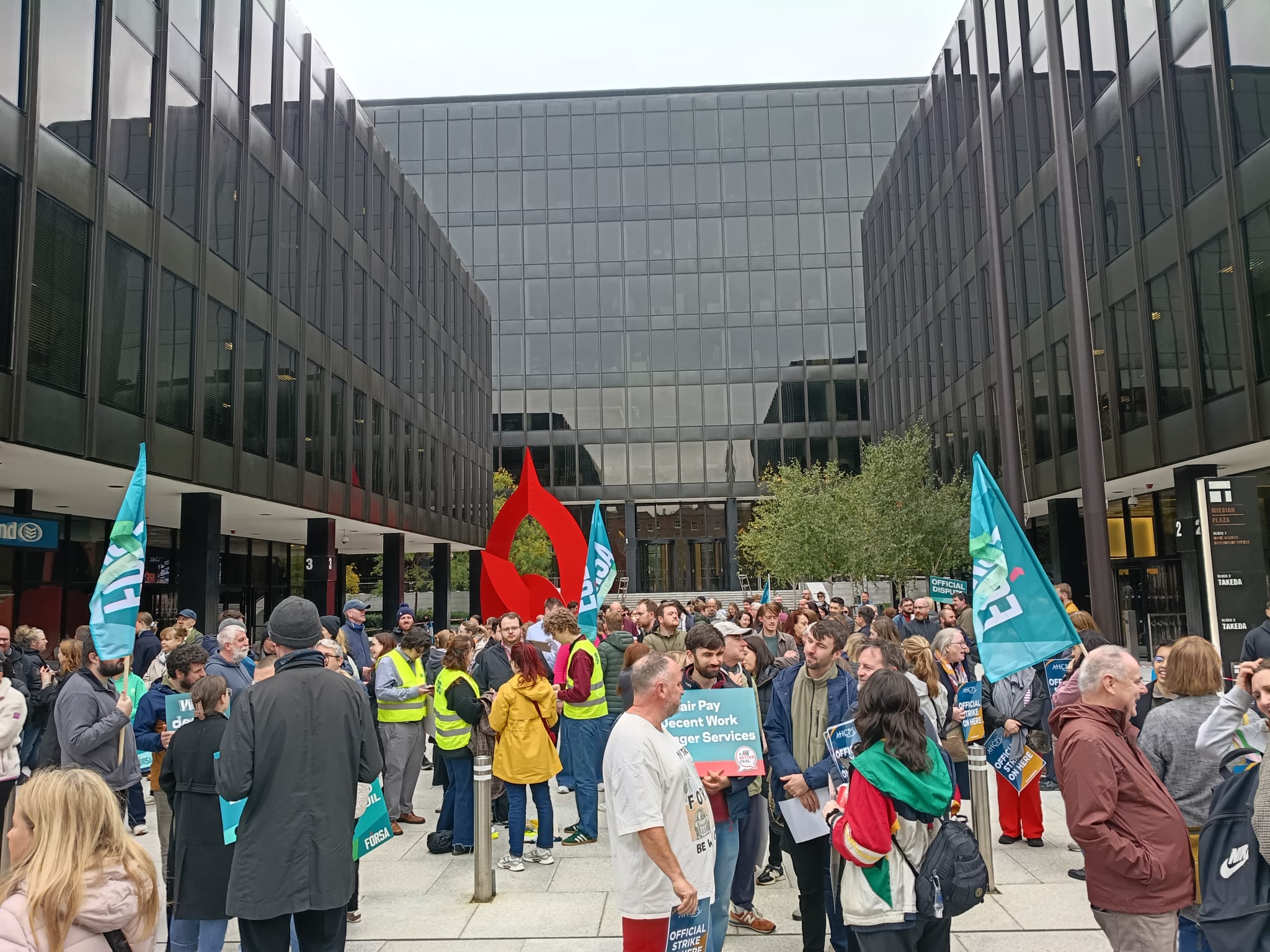
On Friday, talks between the government and the trade unions in the Workplace Relations Commission (WRC) collapsed after ten days. On Monday morning, unions announced that a second public sector strike will take place on Thursday 12 November. This time, the strike action will be accompanied by a rally in Dublin and other locations.
This is taking place in the context of continued militant mobilisations by workers and youth in France, Spain, Portugal and beyond. If the 12 November strike goes ahead, it will take place during a major meeting of European leaders in Dublin. Moreover, the date will coincide with a planned five-day work-to-rule by Gardaí. Talk about flammable material!
The collapse of talks demonstrates that suspending the strike originally planned for 21 October was a mistake, as we warned at the time. The urgent task now is to build for the 12th and make concrete plans for escalation. Not another strike must be called off without a deal on the table that makes up for losses to real pay and guarantees future wages will be protected from inflation!
14 October – an historic mobilisation
14 October saw the first all-out public sector strike since 2009. With over 300,000 workers downing tools, this was the biggest day of strike action in Ireland since the monumental movement for PAYE reform in the 1980s.
The mood on the picket lines was one of firm resolve. RCI supporters spoke to numerous striking workers who detailed the impact on their lives of real pay erosion to the tune of 5 to 7.5 percent in the past five years. They emphasised that the decision to strike is not one they took lightly, but that they are ready to fight for as long as it takes for a decent pay deal.
There was a wholesale campaign by the government and the establishment media to turn public sympathy away from the striking workers, but this failed to cut ice. On 14 October there were cases of Dublin Bus drivers, who aren’t employed directly by the state and hence weren’t balloted for action, changing their bus routes to avoid crossing picket lines.
Indeed, a poll in the Sunday Independent found 72 percent in support of the striking workers. The vast majority of workers understand instinctively that this is their struggle also.
Why was the 21 October strike suspended?
The same poll found that 77 percent believe correctly that workers will secure a better deal if they push ahead with further strike action.
Unfortunately, after the 14 October strike, the union leadership did not seem to agree. Instead of pushing forward with the planned follow-up strike on 21 October, all 19 unions affiliated to the ICTU public services committee suspended further strike action in order to enter talks with the government at the WRC.
Calling off the 21 October strike was a mistake. A second day of strike action, together with a plan of escalation, would have been a thousand times more effective at achieving a decent pay deal than all the talks in the world.
According to Fórsa General Secretary Kevin Callinan, suspending the strike was a good will gesture. Imagine that! For years, public sector workers have seen their real wages eroded. The government is now saying that any pay increase will have to include “productivity” measures – meaning greater intensity of labour, i.e. worse conditions – while workers are already stretched to their limits. And the union leadership apparently felt the need to demonstrate their “good will”. At which point has the government shown a modicum of good will?
Frankly, it seems clear that this was the plan of the union leadership from the get-go. Allow for one day of strike action as an escape valve for the anger of workers and to show that the union tops are willing to put up a fight, then take the first opportunity to sit down for talks.
Incidentally, it was around this time that Callinan dropped all mention of pay being indexed to inflation. He began moderating his rhetoric to prepare his members for a bad deal.
What the union bureaucracy fears is that a prolonged strike could quickly escape their control. Once workers get a sense of their power, they will become less likely to accept a sub-par deal. The Irish Times put it well:
“A protracted period on the picket lines can harden attitudes and make the eventual compromise – if and when it comes – harder to sell. Union leaders are always aware that after any deal is done they then have to go and persuade their memberships that no better deal is on offer. Sometimes that can be harder than agreeing the deal in the first place.”
The Business Post spelled it out even more plainly:
“[The union leaders] are wily and experienced. They’re not wild-eyed Arthur Scargill-style militants gagging to take on – or out – the establishment. […] Unlike the fuel protestors, the coalition can do business with the union leadership. [our emphasis]”
What now?
As the talks neared an impasse, Callinan – despite his ‘best efforts’ – was left with no choice but to threaten another strike. He undoubtedly hoped this would be enough to get a last-minute deal over the line he could sell to his members. Instead, the collapse of the talks exposed the bankruptcy of the union bureaucracy’s spineless conduct.
As a statement by SIPTU put it, “It does not appear possible, at this time, to negotiate an agreement that unions could confidently put to members in a ballot.” In other words, they were worried that any deal they put to a vote now would be defeated, massively undermining their authority.
The decision to cancel the 21 October strike means that valuable time and momentum has been wasted. But in spite of that, it’s clear that workers are still prepared to fight.
Enough dithering! Building must now take place for 12 November as a matter of urgency. Moreover, the unions must put in place a concrete plan for escalation. We have already seen that the government can wait out an isolated day of action.
If 12 November does not produce a pay deal that covers the past five years of cuts to real pay and protects future pay from inflation without any so-called “productivity measures”, the next step must be a two-day strike, and more, leading up to an indefinite work stoppage if necessary. And not another strike is to be suspended as a ‘good will gesture’ until a real deal is wrested from the government’s hands!
Across Europe, workers and young people are fighting back against years of attacks on their living standards. We call on all class-conscious workers and youth to come out on the 12th to make this largest mobilisation possible. This is the chance for the Irish working class to enter the stage of the Europe-wide revolt.