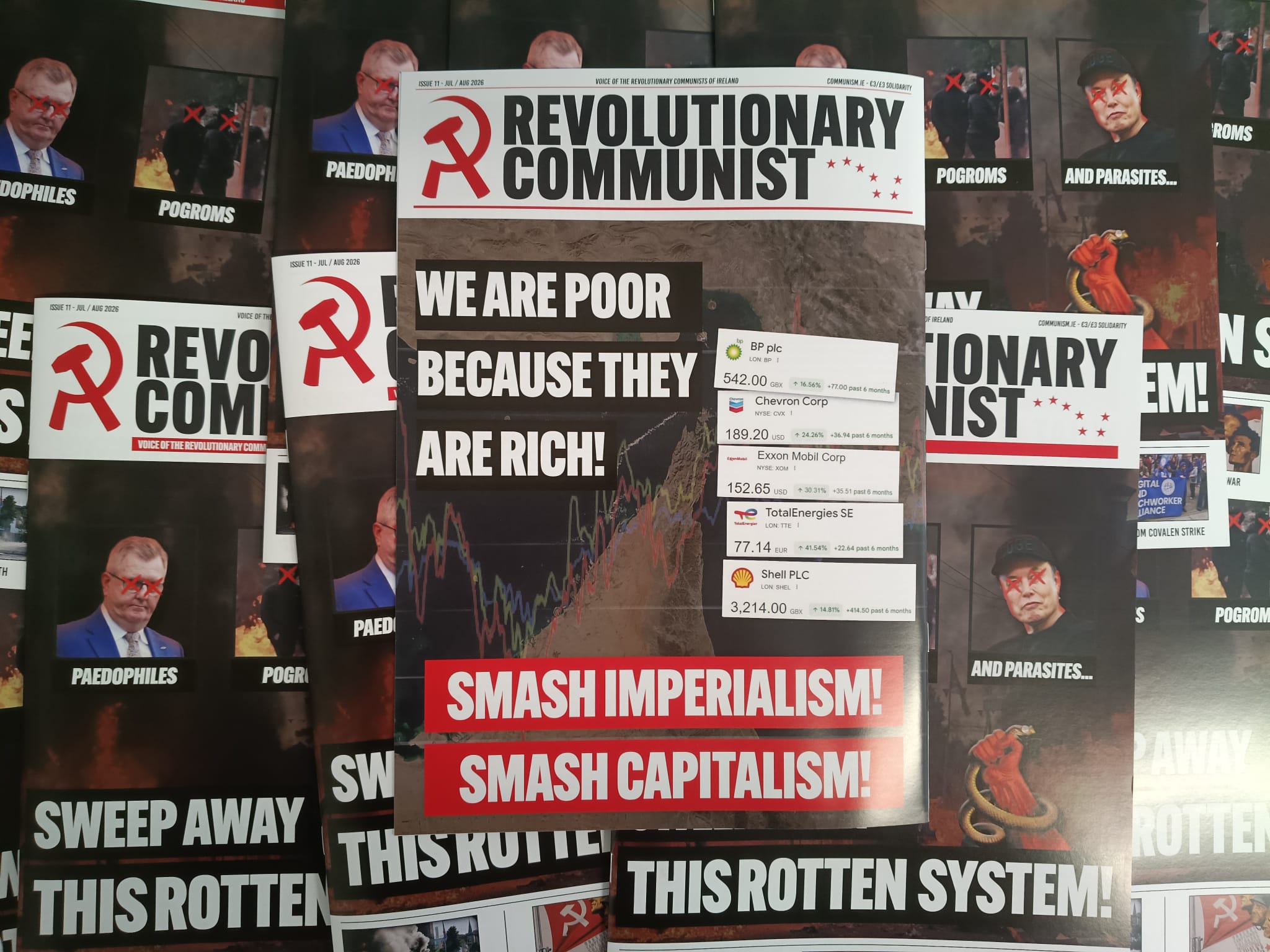
The eleventh issue of the Revolutionary Communist is coming out this week! Read the editorial of this issue below, and set up a physical or digital subscription now. Or meet us at one of our regular stalls to buy a copy directly from our comrades. Every subscription and paper bought will help us strengthen the revolutionary press, produce more regular articles and analysis, and advance the fight for communism in Ireland!
Safe in the thought that a French air-defence frigate sitting off Dublin Bay was ‘defending’ them from incoming swarms of pesky Russian drones, Ireland launched its six-month EU presidency in Dublin Castle with all the pomp and ceremony such an occasion demanded.
Nothing was spared: Garda escorts, motorcades, screens, helicopters, complimentary packs of Tayto. Even Ukrainian President Volodymyr Zelensky was once again wheeled out by the government to promote its ‘security’, anti-neutrality agenda.
In fact, Ireland is sparing no expense for this presidency. The bill is expected to reach around €300 million, much of it devoted to security measures. That is roughly three times what the last two rotating presidencies, Cyprus and Denmark, spent. But then again, with such a healthy budget surplus, what else could the government spend the money on?
No less grandiose are the objectives Ireland has set for itself. As Minister for Foreign Affairs Helen McEntee explained: “we aim to enhance the competitiveness of Europe’s economy, safeguard the fundamental values of our union… and provide for the security of our citizens”.
We wish these valiant champions of competitiveness, security and values (incidentally, do those values include genocide, Minister?) the very best of luck in their noble endeavour. Unfortunately, we fear reality is likely to prove rather less accommodating…
Riven by internal divisions, squeezed by its American ‘ally’ across the Atlantic, outcompeted by China, the EU enters Ireland’s presidency at a time when its capitalist model is crumbling. Nor is the Irish government itself in any stronger position. Behind the photo opportunities and diplomatic theatre, Fianna Fáil and Fine Gael face growing domestic pressures that six months of European pageantry will do nothing to resolve. On the contrary…
Splits and tariffs
Just days before Ireland assumed the presidency, Trump was back to one of his favourite pastimes: threatening Europe with tariffs. This time it was a 100 percent tariff on EU countries that levy digital service taxes on Big Tech. This just as the European Parliament has recommended a similar tax to be introduced across the EU.
Ireland finds itself caught squarely in the middle – just at the time when it’s holding the rotating presidency. It is home to the European headquarters of many of the very corporations affected, and in fact successive Irish governments have frequently done their bidding within the EU – much to the irritation of Brussels.
But it is not just about digital tax. Following the humiliation suffered by US imperialism in Iran, and with midterm elections looming, Trump’s behaviour is likely to become even more erratic and aggressive as he searches for easy wins. Weak and divided Europe presents an obvious target.
Meanwhile, a new review of American troop deployment on the continent is ongoing, with the view to implement more cuts. This is the real driving force behind Europe’s frantic obsession with ‘security’. The idea that Russia is poised to roll its tanks across one EU country after another is absurd. The real problem confronting Europe’s ruling classes is that, for decades, they relied upon American imperialism to defend their interests abroad. Now they increasingly have to fend for themselves.
Hence, the endless scaremongering about drones, cyber warfare and ‘hybrid threats’. Hence, the show of battleships parked just off Dublin’s coast. The objective is not to defend the people of Ireland – or indeed Germany or France – but to strengthen the capacity of European imperialism to defend its own interests in Eastern Europe, North Africa and wherever else they may be challenged.
Nor is the EU a single, unified capitalist country. It’s made up of 27 national ruling classes, with 27 distinct national interests. There are splits on how to react to all the issues facing the bloc – the Ukraine War, Russia, the US, China, AI, Iran, energy…
The more serious strategists of European capitalism recognise the scale of the problem. Mario Draghi’s report two years ago was, in effect, an admission that European capitalism is steadily falling behind its principal rivals.
So much for competitiveness and security.
The budget and the government
But what about Ireland? “This EU presidency couldn’t come at a worse time for Ireland’s economic future,” writes an opinion piece in the Irish Times. It goes on to explain:
“While our Government parties are still dreaming of income tax cuts in forthcoming budgets, most economists are predicting various shades of financial Armageddon.”
Now, our writer here is a member of a right-wing think tank, so of course he doesn’t take issue with the money being splashed at multi-nationals, but with the prospect of a so-called tax cut (that will barely catch up with inflation) for the rest of us. But he does have something of a point.
Stripped of windfalls, Ireland is set to run an underlying budget deficit of 6 percent by 2030. It is not by chance that the IMF has come up with ‘suggestions’ to the Irish government to “avoid injecting unnecessary demand stimulus” (i.e. help workers with the cost-of-living crisis) despite the big budget surpluses.
Only three months separate us from the next budget. Already, the annual horse-trading has begun, with endless lectures against excessive spending. Fianna Fáil and Fine Gael find themselves caught in a vice: squeezed from above by the demands of capital, and from below by mounting anger over falling living standards.
The coalition’s political position reflects these contradictions. Together, Fianna Fáil and Fine Gael are polling around historic lows. In the latest Red C poll, Fianna Fáil has fallen to just 14 per cent, barely ahead of the Social Democrats. The latter and Sinn Féin when taken together are just above the combined FF-FG support.
The EU Presidency is not going to help with any of this. In fact the same poll has found the majority to be opposed to the key policies Ireland wants to champion in the Council, including expansion of the EU, bolstering of military spending and heavier regulation on Big Tech (the Irish government being against). Actually, in so far as workers look towards the EU, it can only further discredit them.
What next?
One of the main stories of this Dáil has been the steady rise of the Social Democrats. They are now within touching distance of the Taoiseach’s party in the polls, and command around a quarter of the vote amongst the youth.
The explanation is not difficult to find. With Sinn Féin’s recent anaemic performances and their shift in rhetoric, the Social Democrats appear to be the most left-wing alternative, and they are relatively untested.
Despite the pessimism so widespread on the left, it is clear that the working class is not in fact shifting towards the right in block. What we are witnessing is the continuing erosion of support for the traditional parties. As the crisis of capitalism deepens, workers searching for answers will be pulled in different directions.
The point however is that a solution to the crisis cannot be found under capitalism. We have been here already, with the Labour Party in the immediate aftermath of 2008, with Sinn Féin in 2020, and now with the Social Democrats.
The future prospect is one of an intensification of the crisis felt by workers and young people, with a consequent greater fracturing of the political landscape. More and more workers and young people are looking for an alternative. The task for Marxists is to ensure they find one. The opportunities for revolutionary communism in Ireland are growing. The urgent task is to build a genuine Bolshevik party capable of preparing for the class battles that lie ahead.