The fourteenth issue of the Revolutionary Communist is coming out this week! Read the editorial of this issue below, and set up a physical or digital subscription now. Or meet us at one of our regular stalls to buy a copy directly from our comrades. Every subscription and paper bought will help us strengthen the revolutionary press, produce more regular articles and analysis, and advance the fight for communism in Ireland!
Spain, Italy, Belgium, Serbia, Albania, Greece, Portugal, and – above all – France.
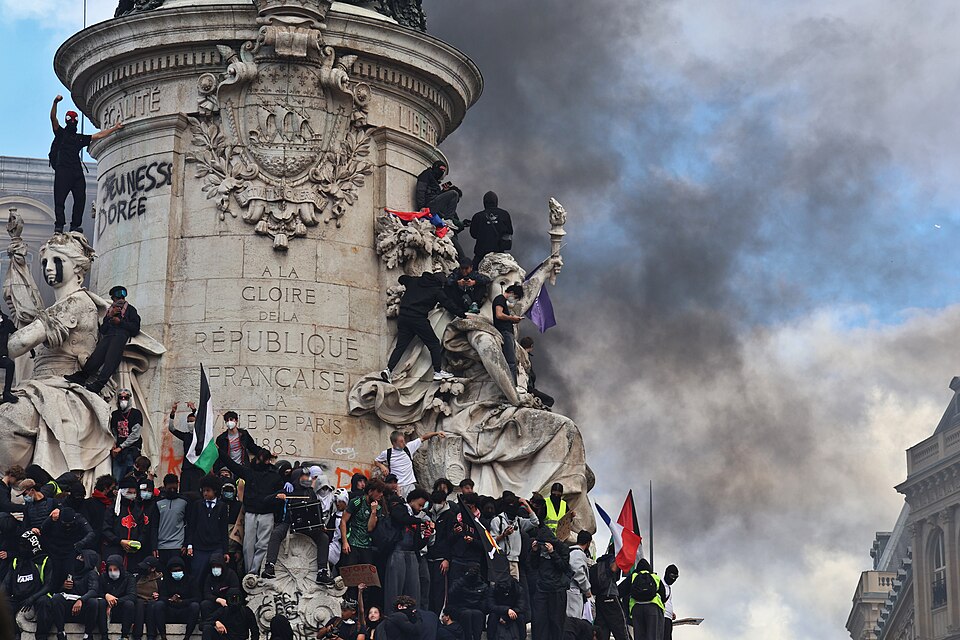
As we go to press, the so-called Gen Z revolutions have reached Europe. The movements that have swept across South and South-East Asia in recent years – from Sri Lanka and Bangladesh to Nepal, Indonesia, Timor-Leste and beyond – have now found a fresh, new expression on European soil.
Years of capitalist crisis, austerity, spiralling living costs and relentless attacks on workers and youth – combined with the criminal actions of the imperialists all around the world – are driving hundreds of thousands onto the streets.
Young people in particular – who rightly feel robbed of a future under capitalism – have been at the forefront of the movements. In some places, like in France and Albania, we have even seen teenagers confronting riot police in courageous street battles.
For all those on the left – including some self-proclaimed Marxists – who have long since written off the European working class, this should be the final nail in the coffin of their defeatism.
We have been told time and again that such militant movements might be possible in some far-flung corner of the world, but certainly not in Europe. Here, we are assured, the working class is too stupid, too comfortable, or, sometimes, too racist, to fight for a different society. The events unfolding before our eyes are a brutal refutation of this nonsense.
To be sure, the same conditions that are leading the youth into struggle on the continent are present in Ireland as well. And as science teaches us, similar conditions will eventually produce similar results.
Revolutionary communists must prepare now for the movements that will erupt in Ireland in the coming period. A new 1968 is in the air!
Ireland
Let’s start with France, where the appalling conditions facing school students have helped fuel the current mobilisation: teacher shortages, dilapidated buildings, overcrowded classrooms and more. And then the very politicians presiding over this assault on education – and, with it, the future of an entire generation – have the cheek to go on television condemning “appalling” scenes of violence when a few windows are smashed.
But what about Irish schools?
It turns out that Ireland has the largest average primary-school class sizes in the EU, at around 23 pupils per class. In fact, the Irish education system is also suffering a serious recruitment crisis, with more than a thousand teaching posts unfilled.
Despite Fianna Fáil and Fine Gael banging on about record spending, the reality on the ground is altogether different. According to a recent report by the Central Statistics Office, between 2021 and 2023, real public current expenditure on education – adjusted for inflation – fell from €12.3 billion to €11.3 billion. That is a real-terms cut of more than 8 percent.
When it comes to housing – the spark that lit huge protests in Madrid and elsewhere in Spain – Ireland fares no better. Actually, in many respects, Ireland fares much worse.
Almost 18,000 people are living in emergency accommodation in Ireland – a threefold increase over the past decade. Meanwhile, rents and house prices have soared far beyond the reach of young workers. Rents are up 81 percent over the last decade, and average house prices have increased by more than 90 percent. Average wages, by contrast, have risen by less than 50 percent.
A whole generation has been locked out of housing.
Budgets and Surpluses
On one count is Ireland different from its neighbours on the continent. While the Irish state is raking in record budget surpluses, France, Britain, Spain, Italy and others are running significant deficits.
But what are Ireland’s surpluses built on? An unprecedented inflow of tax revenue from a handful of multinational corporations, above all big tech. And what happens when that revenue dries up?
Already, the more serious strategists of capital can see that the momentum behind the AI speculative bubble is decreasing.
Just in October, CalPERS – the US’s largest retirement fund for government workers worth more than half a trillion dollars – has reduced its combined holdings in big tech by 26 percent. Earlier in the month, Meta’s announcements about its investment plans triggered a sell-off that left – in the immediate aftermath – the Nasdaq-100 down 7.7 percent from its all-time high.
Those are but early symptoms of the inevitable bursting of the bubble. The consequences for the Irish exchequer could be nothing short of catastrophic. Record budget surpluses will turn into a gaping black hole in the country’s finances.
Already, like anywhere else around Europe, the living conditions of the working class – and especially of the youth – have been battered over the last 15 years.
Already, a tremendous amount of anger against the establishment is bubbling beneath the surface desperately looking for an expression – as shown for example by the latest Red C opinion poll, which put the combined support for Fianna Fáil and Fine Gael at the historic low of 30 percent.
Already, we have witnessed the biggest day of strike action since all the way back to the 1980s. Just imagine what will happen when the government’s wriggle room for concessions will disappear.
Already, like in France, like in Spain, like in Albania – only a spark is needed to set the whole situation ablaze.
A new ’68?
To be sure, it is not just in the South that the combustible material for a social explosion is accumulating.
Workers and young people in the Six Counties already fare worse than their counterparts south of the border in many respects. Against this background, the events in Drumcree have been like a political earthquake – the aftershocks of which we are only now beginning to see.
Much has been written about the parallels between the protests rocking France today and the events of May 1968. Similarly, we believe there are important parallels between the events now unfolding in the North of Ireland and the period leading up to the social explosion of 1968–69.
After decades of frustrated attempts to secure change through the old Stormont Parliament – and amid a wave of youth radicalisation sweeping Europe and America – a small group of determined activists in Derry and Belfast took up the demand for Catholic equality, and they quickly found themselves at the head of mass protests involving thousands. When the RUC brutally attacked demonstrators in Derry on 5 October 1968, suddenly the civil rights movement erupted onto the scene in all its force.
It’s impossible not to see the parallels with the mass protests on the Garvaghy Road in solidarity with the Residents Coalition. Indeed, the PSNI itself recognised the danger, warning the Secretary of State that forcing through the Orange procession risked provoking a much wider social explosion.
But what key lesson emerged from the events of the 1960s? Despite the boldness and militancy shown by many, without a genuine revolutionary organisation, armed with a programme capable of linking the national question to the social question – and through that, uniting the most advanced layers of workers and youth in the struggle – those mass movements were eventually derailed. In the North, decades of sectarian conflict followed.
We cannot afford to learn these lessons too late. Major opportunities are opening up before us to build a revolutionary organisation in Ireland. But opportunities do not last forever, and history will not wait for us. The party to overthrow capitalism needs to be built now!