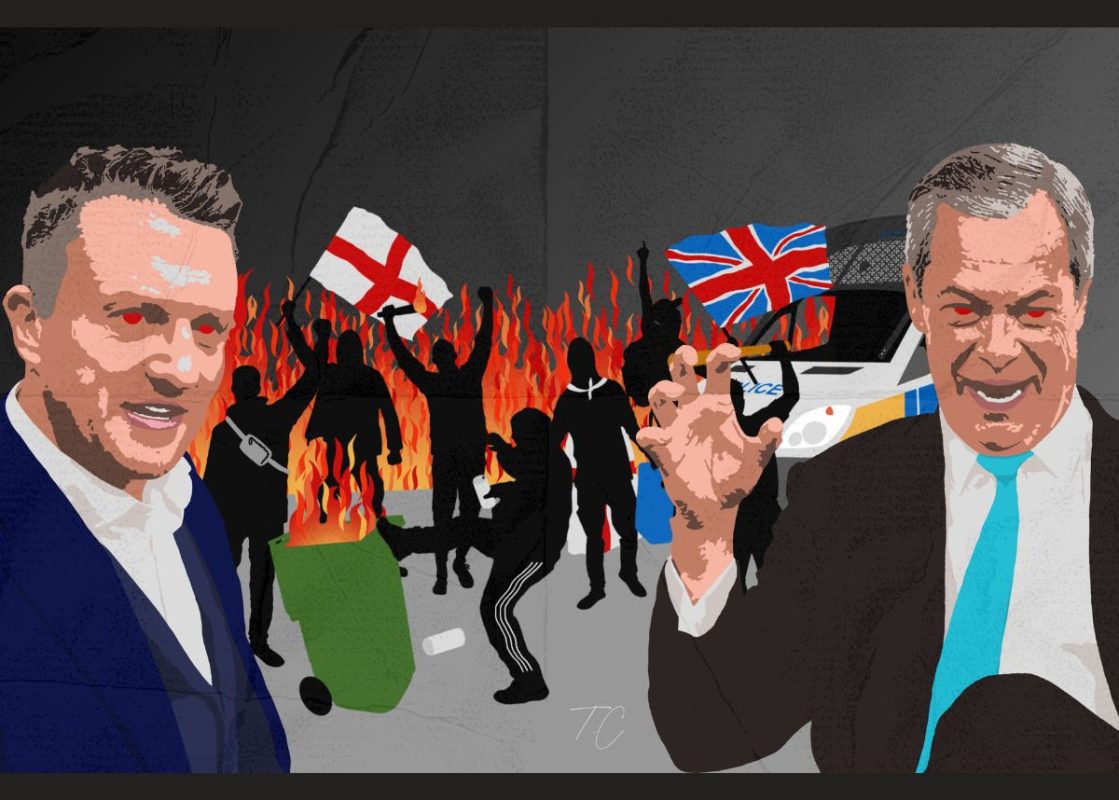
In light of this week’s pogroms in Belfast, we republish the following article by the British section of the Revolutionary Communist International. Here the role of reactionary demagogues such as Nigel Farage and Rupert Lowe is discussed in stoking such explosions as we have seen in recent days.
Nigel Farage called for “pure, cold rage” last week, in response to the killing of Henry Nowak. With violence in Southampton, Belfast, and Glasgow, he’s got what he asked for. But what lies behind Reform’s reactionary provocations? And where will it lead?
“Henry’s family have responded to this in just the most extraordinarily dignified way. But I suggest the rest of us respond to this with pure, cold rage.”
This was how Nigel Farage responded to last week’s news surrounding the tragic death of Henry Nowak, who was murdered by a Sikh man, and left to die in handcuffs by careless, negligent police officers.
In his “emergency address to the nation”, the Reform leader weaponised this murder to demonise immigrants and racial minorities – who are “leaving our cities culturally unrecognisable” – and to rally against Britain’s “two-tier culture” of “anti-white discrimination” against “people whose ancestors may have lived in Britain for centuries”.
How else, in a febrile and polarised political climate, could these venomous words have been interpreted other than an open incitement to violent unrest and racial hatred? We all saw the far-right riots and pogroms in the summer of 2024, following the Southport stabbings. Farage knows full well the danger posed by such reckless rhetoric.
Farage got the “pure, cold rage” he was after. On the streets of Southampton, a reactionary mob – under the pretence of a protest and vigil for the murdered teenager – terrorised local residents: burning bins, smashing up windows, and clashing with police on the streets.
The following day in Parliament – faced with the heckles, jeers, and hypocritical denunciations of MPs from the other establishment parties – the Reform leader refused to condemn the violence, warning instead that the anger on the streets “is in danger of getting considerably worse”.
And so it did. One week later, on Monday 8 June, footage went viral of a Sudanese man attempting to behead another man on the streets of Belfast in the North of Ireland.
Immediately, the far-right, migrant-baiting propaganda mill went into overdrive. Mouth-throthing scum like Rupert Lowe, Elon Musk, and Tommy Robinson leapt at the opportunity to flood their X feeds with calls for “mass deportations” of “invaders”, and to put “murderous third-world savages to death”.
The inevitable result: days of violent pogroms in Belfast; gangs going around door-to-door burning migrants’ houses and vehicles; checkpoints set up by masked rioters to identify black and Asian people; clashes in the streets.
And all of this has been broadcast far and wide by far-right figures, with barely-concealed glee, and only the faintest whiff of feigned condemnation of the most excessive violence.
We must say it plainly: Nigel Farage, Rupert Lowe, Tommy Robinson, and Elon Musk are nothing but a gang of pogrom-mongerers. By sowing racist bile and division, these demagogues are whipping up the forces of barbarism in Britain and the North of Ireland.
Labour’s pathetic response
And throughout all of this, what do the establishment politicians like Keir Starmer and his potential successor Andy Burnham have to say?
Besides the Prime Minister’s usual hymnals and sermons against violence, and his grand-standing threats to deploy the “full force of the law”, he can offer no real explanation for why such lawless chaos is repeatedly breaking out under his ‘leadership’ – nor how to stop it.
Labour leadership hopeful Andy Burnham, meanwhile, told BBC Radio Manchester earlier this week that he does “agree with what Farage is saying” on immigration. “What we’ve got to do is get back to a sense of order,” he said, “the government must go further”. And some ‘lefts’ hail this man as our saviour!
These spineless cretins don’t have a leg to stand on. Try as they might to use this unrest to score points against Farage, the fact remains that the Labour government has paved the way for these reactionary events.
As with the Tories before them, Labour has failed to solve a single one of the problems facing deprived and working-class communities. In fact, they have exacerbated them, by carrying out austerity attacks on behalf of the capitalist class.
And then, flailing around to stem their haemorrhaging support, Labour ministers have sought to outflank Reform on questions of immigration, law, and order – with their vicious clampdowns on asylum seekers, for example. This has only further emboldened the reactionary right.
Needless to say, you cannot fight rioters and pogromists with moral denunciations, nor with threats of state repression, and nor by engaging with and bending to their anti-migrant logic. Labour – under any leader – cannot be trusted to curb right-wing violence, nor to protect communities from it. They are stoking the fires just as much as anyone else, by tying themselves to the crisis-ridden capitalist system.
Why is Farage doing this?
Farage’s comments in the past week or so mark a step-up in his reactionary, culture-war agenda.
Farage has, of course, never shied away from sowing racist and anti-migrant division. But he usually does it in a more subtle, dog-whistle fashion – eager to distance his party from the far right and its street movement, and to keep his more ‘respectable’ brand of reaction untarnished.
He has often boasted, for example, that his previous UKIP outfit was responsible for the demise of the far-right British National Party, and that he has done “more to stop the far right more than anyone”.
But his latest address was openly nativist and ethno-nationalist in its message. This pandering to the most reactionary dregs of society is on a new level. What can explain this recent lurch to the right?
Reform has lost some of its anti-establishment edge in the past year. It has ditched its left-sounding talk about nationalisation and ‘raiding the banks’; welcomed unpopular, ex-Tory careerists into its ranks; and overseen austerity and chaos in the local councils that it controls.
Farage’s party is still miles ahead of its rivals in the polls, and this cannot be overstated. But this shedding of its insurgent image can partly explain Reform’s recent plateau and relative drop in the polls in the past couple of months.
Farage is therefore grasping for anything he can find to fill that void, and re-galvanise a reactionary section of his heterogeneous base. Ramping up the extent and intensity of his culture-war agenda is the obvious first choice for a reactionary demagogue like him.
As we predicted just over half a year ago:
“All the while, unable to meet the contradictory demands of those looking towards Reform, Farage and his party will be forced to rely even more on whipping up racism and leaning on culture-war rhetoric.”
Henry Nowak’s death therefore fell into Farage’s lap as the perfect political football to cynically kick around, in the hopes of scoring some cheap and easy victories against Labour, and dishing out some red meat to his most reactionary supporters.
Does this rightward shift falsify the idea that Farage is moving towards the ‘centre-ground’ and the establishment, as we have commented in our previous material? Not at all.
By lurching to the right on questions of immigration and the culture war, Farage is hoping to provide cover for his shift toward an establishment-friendly position on the economy and public spending. These two contradictory processes are actually interlinked.
What role does Restore play?
On top of this, Reform is most definitely feeling pressure from Rupert Lowe’s newly-formed Restore Britain party – a hardline right-wing splinter from Farage’s outfit, which calls for mass deportations, and denounces Farage as a bleeding-heart liberal.
We have previously described Restore as a relatively small, fringe outfit, which would require massive events to be propelled into electoral significance. This undoubtedly remains true.
But evidently, despite their small size and extremely reactionary politics, this party has proven to be more than a flash in the pan; they have become significant enough – partly with Elon Musk’s backing – to be a persistent thorn in Farage’s side.
There are polls which suggest that Restore is polling at 7 or even 13 percent in the Makerfield by-election, which is a contest of national importance, given that it could decide the next Prime Minister.
A split in the right-wing vote looks like it might end up costing Reform this election, which would be another blow for Farage following his party’s defeat to the Greens in Gorton & Denton.
Restore will likely remain a fringe group, but it doesn’t need to become more than that to have an impact on events. It is already beginning to act upon Reform in the same manner as Farage’s UKIP did upon the Tories back in the 2010s: as a small pressure group that can pull its rival rightwards.
In that sense, Restore has become nationally significant, without gaining – or needing to gain – much of an electoral foothold.
Playing with fire
With his recent lunge to the right, Farage is playing with fire. His reckless, provocative comments may sabotage his pro-establishment overtures, and tarnish his ‘respectable’ brand.
This kind of odious nativism and overt racism is a step too far for a chunk of Reform’s electoral base – the more moderate ex-Tory and ex-Labour types – who are less interested in this culture-war nonsense. A section of current and potential Reform voters will likely be put off by Farage’s latest reactionary binge.
Farage is therefore pressured from all sides. Each shift that he is forced to make to placate one section of his social base risks incensing another. And this is only a foretaste of the instability to come should he get the keys to 10 Downing Street.
If the recent riots spiral into a summer of unrest like we saw in 2024, Farage would be left in a very difficult and uncomfortable situation, having helped spawn a movement that would divide the nation, and likely the ranks of his own party and base.
Nor will such chaos help ingratiate the Reform leader with the capitalist class, who may soon be forced to hand over the reins of the British state to this maverick.
However events pan out – and this is hard to foresee exactly, at this stage – it is clear that Reform’s unstable, cross-class coalition has dynamite built into its foundations.
Will this spread?
So far, the response to these two stabbings, in Southampton and Belfast, has been comparatively smaller on the streets of Britain than in the North of Ireland.
Belfast has become a flashpoint because of the specific context of reactionary Loyalist paramilitaries ready to whip up violence, the festering crisis of Unionism, and the extreme deprivation in the North of Ireland, which makes it a fertile ground for racist demagogy, as we saw with the Ballymena riots last year.
But the threat of disorder in the rest of the UK cannot be overlooked. Hundreds of masked thugs turned out in Glasgow this week, and dozens turned out in other cities and towns in England. Robinson and Lowe are doing their best to fan the flames and foment unrest.
Anger and tension are simmering beneath the surface. None of the objective conditions which led to the riots and pogroms of 2024 have gone away. Left-behind communities have sunk even further into deprivation, dejection, and misery – thanks to the austerity and decline meted out by Starmer and Co.
Meanwhile, right-wing culture warriors are trying to fill the vacuum left by a weak, incapable, out-of-touch left leadership. They are tapping into the overwhelming anger in society, and directing it down reactionary channels. A social explosion could arrive at any point.
The organisations of the working class must remain vigilant. These threats must be countered by a serious show of force and unity by workers, youth, and local communities.
The left leaders – particularly the leaders of the trade union and anti-racist movements – must take responsibility, and prepare to physically defend black and Asian communities from this far-right menace.
More broadly, instead of sowing illusions in the latest Labour leader, the left leaders must undercut the racist demagogy of the right, by providing a revolutionary programme to tackle society’s problems.
This means pinning the blame for the crisis on our real enemies: the landlords who hoard the housing, the billionaires and bankers who rinse and exploit us, and this treacherous Labour government which is overseeing austerity and decline. We must turn the right wing’s culture war into a class war.
An explosion is coming
The nation sits atop a powder keg. Starmer has spent the last two years dousing the country with petrol, while giving nasally lectures on fire safety. Farage, Lowe, and Robinson are running around like pyromaniacs, with torches and bellows in their hands. Elon Musk, meanwhile, is lobbing Molotov cocktails across the Atlantic, just to see what catches.
Your explosion is coming, gentlemen – but not in the way you imagine. Just as the 2024 riots were met with a militant response by workers and youth – who sent the far-right thugs packing with their tail between their legs – so too will your pogrom-mongering be met with an almighty backlash today, should it take root.
This period of capitalist death agony is undoubtedly dredging up the reactionary forces festering within society. But in far greater measure it is dredging up the class resentment of millions of workers and young people – against the billionaire class, its establishment politicians, as well as the right-wing demagogues and their knuckle-dragging footsoldiers.
This is the real majority in society, not the barbarians running amok on the streets of Belfast, Glasgow, and Southampton.
Those who are trying to fan the flames of unrest and division should heed Hosea’s warning to the Israelites: those who go around sowing wind shall reap the whirlwind. We are that whirlwind, and we will tear you down.