The criminal offensive by US imperialism against Venezuela on 3 January has put the country back in the international spotlight. The outrage sparked by this military aggression has been accompanied by a discussion on the left about the Bolivarian Revolution that developed after Hugo Chávez’s victory in the 1998 presidential election.
[This article was originally published in French at marxiste.org, get your copy of the new and improved edition of Wellred Books’ The Venezuelan Revolution: A Marxist Perspective here]
Our International has very actively defended the Venezuelan revolution against its detractors (both on the right and on the ‘left’). In the early 2000s, we launched an international campaign called ‘Hands off Venezuela!’ We published a large number of articles on this theme. But to get a very concrete, vivid idea of what the Venezuelan Revolution was all about, you absolutely must watch a documentary called ‘The Revolution Will Not Be Televised’.
Its two directors, Kim Bartley and Donnacha O’Briain, arrived in Caracas in September 2001. Their intention was to paint a portrait of Chávez. But, at the same time, the Venezuelan opposition and the US administration were drawing up a battle plan to overthrow the regime and crush the revolution. This reactionary offensive culminated on 11 April 2002 in an attempted coup d’état. Within 48 hours, that coup had failed in the face of mass mobilisation and the opposition of a large section of the army.
Bartley and O’Briain’s film crew recorded these major events day by day, then hour by hour. The result gives us a glimpse of what a genuine revolution looks like.
Chávez and the masses
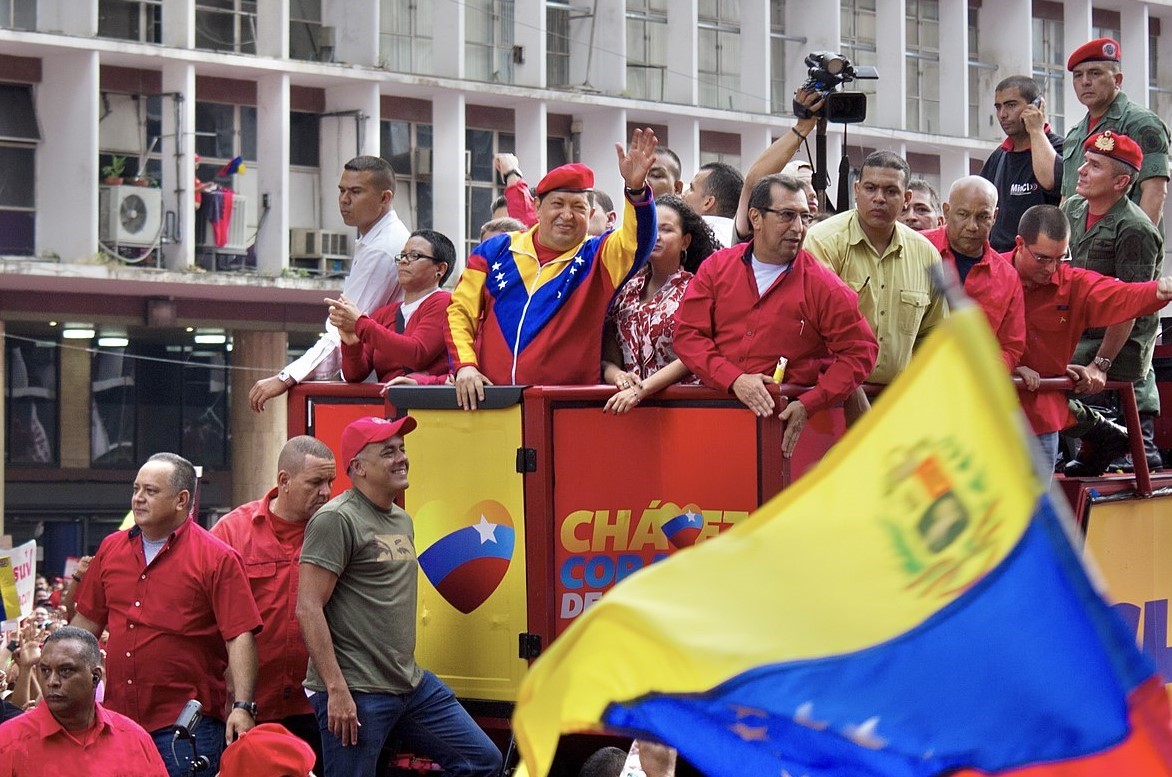
In accordance with the initial project, the documentary begins by describing the powerful relationship between the oppressed masses of Venezuela – the overwhelming majority of whom live below the poverty line – and their president, Hugo Chávez, whom they supported with almost religious fervour.
We see and hear what our comrade Alan Woods explained in an article published in 2004:
“With every fibre of their being, they yearn for a fundamental change in the conditions of their lives. For them, this is what Chavismo means. And this great dream of a change in their lives is summed up in their minds in one man – Hugo Chávez. […]
“They would be ready to suffer hunger and poverty, to sacrifice all their possessions, to risk their lives (as they did two years ago) for him.”
At an open-air rally, Chávez defends his plan to take control of the country’s oil industry – its main economic resource – and finally make it benefit the poorest. Facing tens of thousands of enthusiastic people, he declared loudly and clearly:
“I have had to face very strong international pressure! But I don’t care. If one day I have to go to hell to defend the Bolivarian people of Venezuela, I will go and fight in the depths of darkness!”
Cynical ‘leftists’ will judge this style bombastic. On the contrary, the way Chávez says these words – and the way the masses react to them – highlights his oratorical genius, his ability to stir the hearts and minds of the people.
The documentary also takes us to the bourgeois neighbourhoods of Caracas, where we hear wealthy Venezuelans speak with utter contempt for Chávez, as well as the poor, the exploited and the oppressed. The oligarchy is incensed by this revolution that threatens its power and privileges. One woman declares:
“The people do not understand the concept of sacrifice, nor the value of things. […]
“[Chávez’s] goal is to make us flee the country so that it is left in the hands of inexperienced and worthless people who have never fought for anything”
Macron once described them as “people who are nothing.”
The coup
In February 2002, Chávez announced the restructuring of PDVSA, the country’s oil company, which for decades had made the fortunes of the Venezuelan bourgeoisie and large American companies. Chávez changed the management of PDVSA and significantly tightened the terms of its commercial relations with foreign multinationals. His policy was to use increased oil revenues to develop extensive social programmes in the areas of housing, health and education. As a result of this policy, many Venezuelans saw a doctor for the first time in their lives.
In the eyes of the reactionary oligarchy and American imperialism, this was unacceptable. In Washington, a coup was carefully crafted. Then head of the CIA, George Trenet, declared:
“We are obviously concerned about the situation of our third-largest oil supplier. I believe – and the State Department believes – that Chávez is not concerned about US interests.”
The threat was clear.
On 10 April 2002, private television channels (all hostile to Chávez) broadcast a statement by senior Venezuelan military officers threatening Chávez with a coup if he did not resign. In the wake of this, the head of the employers’ confederation and the opposition, Pedro Carmona, called on his supporters to demonstrate the following day, 11 April.
The documentary then follows, hour by hour, the events of this chaotic and bloody day, which clearly unfolded according to a detailed plan drawn up in Washington. During the night of 11 to 12 April, Chávez was arrested and held captive (no one knows where) by the generals behind the coup. On the morning of 12 April, the Miraflores presidential palace was taken over by the Venezuelan opposition. Amid the general confusion, no one paid any attention to the European film crew inside the palace, who filmed the presidential inauguration of Pedro Carmona and all the events of the following 48 hours.
The new regime made no secret of its dictatorial nature. To the cheers of several hundred reactionaries gathered at Miraflores, one of the coup leaders read an official statement:
“All deputies and substitutes are relieved of their duties in the National Assembly. Also relieved of their duties are: the president and magistrates of the Supreme Court of Justice, the Attorney General of the Republic, the Comptroller General of the Republic, the Ombudsman, and all members of the National Electoral Council.”
The mobilisation of the people
But the very next day, 13 April, the tide turned abruptly. The people revolted and took to the streets despite brutal repression by the Caracas police, who were loyal to the reactionaries. The army split, with the vast majority opposing the coup. Loyal to Chávez, the presidential guard recaptured the palace right under the noses of the coup leaders, who fled or were arrested.
Both inside and outside the presidential palace, the scenes filmed are of a dramatic intensity that even the best fiction rarely matches – precisely because these are real events. At this point in the documentary, its theme is no longer Hugo Chávez; it is the heroism of the masses, their refusal to give in to the reaction, their unwavering determination to save the revolution.
In the early hours of 14 April, Chávez was brought back to the presidential palace. His first words are to ask “all Venezuelans to return home”. He calls on them to “remain calm”. He adds:
“To all those who oppose me, I say: keep going! Of course, I will try to change your minds. But you cannot fight the [Bolivarian] constitution, because it belongs to you. […] You must recognise this.”
Chávez was wrong: the oligarchy would never recognise it and could not recognise it, because its class interests were at stake. A few months later, in December 2002, it attempted another coup, this time in the form of a lock-out by employers and a vast operation to sabotage PDVSA. Once again, it was the mobilisation of the masses – and the PDVSA workers in particular – that saved the revolution.
The Venezuelan oligarchy and US imperialism have never given up on regaining control of the country’s oil industry. To remove this threat once and for all, it would have been necessary to expropriate the Venezuelan oligarchy and foreign multinationals, place the country’s economy in the hands of workers and peasants, break the bourgeois state and replace it with a workers’ state controlled by the masses. In the absence of such a policy, and despite the heroism of the people, the revolution petered out. After Chávez’s death in 2013, the regime led by Maduro has continued to shift to the right, and the gains of the revolution have been gradually liquidated.
The Venezuelan Revolution remains a treasure trove of valuable lessons for all those who want to fight capitalism and imperialism. Many of these lessons can be found in ‘The Revolution Will Not Be Televised’, a masterpiece of documentary filmmaking.
[Get your copy of the new and improved edition of The Venezuelan Revolution: A Marxist Perspective here]