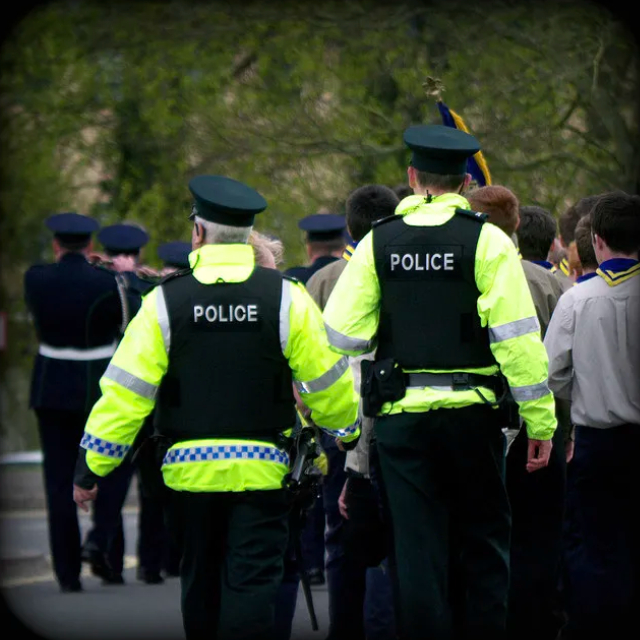
Jon Boutcher, the PSNI’s chief constable, while speaking at a commission on the Kenova report, remarked: “I was at an event on Sunday for … Royal Irish Constabulary (RIC) officers murdered before the creation of the Royal Ulster Constabulary (RUC) by terrorism.”
We hope the irony will not be lost on our readers. While denying once again justice for the victims of the Troubles and of the terrorist actions carried out by the British state, almost in the same breath ‘our’ great chief constable casually branded all the Irish revolutionaries of 1919–1921 as “terrorists.”
Worth noting that under the umbrella of Kenova we also find Operation Denton – headed by the very same Jon Boutcher – which centres on the collusion between the infamous loyalist terrorists of the Glennane Gang and the forces of the British state. We await with interest any equally forceful condemnation of that campaign of murder – the real terrorism, organised and sustained by British imperialism for decades.
To be sure, British state terror is not something specific to the Troubles! Any study of our history reveals that, far from victims Boutcher paints them to be, the RIC were some of the worst terrorists in Ireland. Just during the Irish revolution from 1919 to 1921, this British colonial police force was responsible for well over a thousand murders. Operating from Dublin Castle they planned to drown the Irish Revolution in blood.
They adopted a deliberate tactic of targeting civilians. Sir Henry Wilson, a unionist and general in the British army – so in no way sympathetic to the cause of Ireland – was appalled by their ruthless methods of, as he put it, “out-terrorising the terrorists”.
Britain enlisted the notorious Black and Tans and Auxiliaries to bolster the ranks of the RIC, alongside feral loyalists who were organised into the Specials in the North.
These murderers waged indiscriminate warfare on the population. Retaliatory killings, summary execution, burning and shooting of property. Their legacy is best recalled by events like the 1920 Bloody Sunday massacre – where 14 people crowded at a Gaelic football match were shot dead – the burning of Cork, or the pogrom in Belfast. What else to call this but terrorism?
After partition, the RIC was disbanded and replaced in the North by the RUC. Hardly any better, this sectarian police force became a hotbed of collusion during the Troubles through which the British state worked hand in hand with loyalist paramilitaries to carry out terror in the North.
It’s no wonder that the chief of the PSNI – which replaced the RUC after the Good Friday Agreement – today feels the need to come to the defence of the terrorists of the RIC and RUC. After all, the PSNI is itself just a case of putting old wine in new bottles.
It remains a deeply sectarian police force like its predecessor. And more and more decisively it is being shown as such. Our task is to channel the anger that exists in society today in a revolutionary direction: against imperialism, to overthrow capitalism, undo partition and at last put an end to the long and bloody history of state terror in Ireland.